
Key Highlights
- Global trade is shifting from multilateral globalization to regional and geopolitical trade blocs, driven by supply-chain security, geopolitics, and strategic alliances.
- Trade fragmentation is reshaping imports and exports, with friend-shoring, near-shoring, and regional FTAs gaining priority over cost-driven global sourcing.
- Businesses and governments must adapt to a multi-nodal trade system, balancing efficiency, compliance, and resilience in a more complex global trade landscape.
Global trade is entering a decisive new phase. The era of seamless globalization is defined by open markets, extended supply chains, and multilateral trade rules. It is gradually giving way to a more fragmented world of regional trade blocs, strategic alliances, and geopolitically aligned supply chains. Rising tariffs, trade wars, sanctions, and resilience-first policies are no longer exceptions. They are shaping how countries import, export, and compete globally.
Market Inside helps you understanding where trade is concentrating, which markets are gaining momentum, and how competitors are adapting requires deep, timely visibility into global import-export movements. This is where data becomes the real differentiator.
Which are the top economies in the world?
According to global trade data, the top economies in terms of exports and imports are the United States, China, Germany, Japan, India, the United Kingdom, and France.
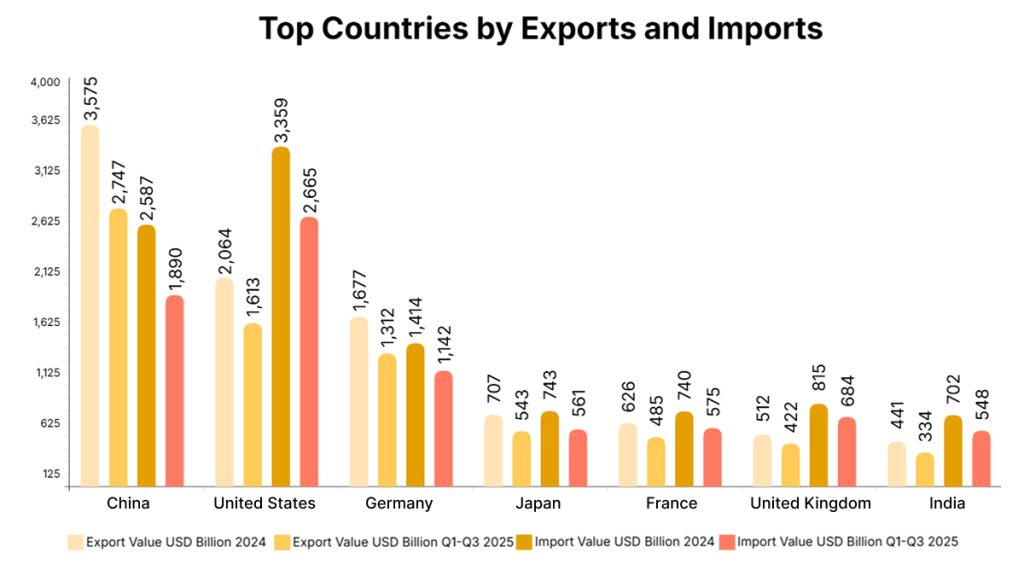
| Country | Export Value USD Billion 2024 | Export Value USD Billion Q1-Q3 2025 | Import Value USD Billion 2024 | Import Value USD Billion Q1-Q3 2025 |
| China | 3,575 | 2,747 | 2,587 | 1,890 |
| United States | 2,064 | 1,613 | 3,359 | 2,665 |
| Germany | 1,677 | 1,312 | 1,414 | 1,142 |
| Japan | 707 | 543 | 743 | 561 |
| France | 626 | 485 | 740 | 575 |
| United Kingdom | 512 | 422 | 815 | 684 |
| India | 441 | 334 | 702 | 548 |
The four nodes of the global trade patchwork scenario
In this trade patchwork scenario four major nodes emerge:
- The US: The United States is taking an “American first” approach that uses industrial interventions in efforts to rebuild the US economic base and bring jobs back to America.
- China: While committed to some multilateral trade agreements and seeking to trade more with the Global South, China emphasizes self-sufficiency and prioritizes access to sources of raw materials as well as final markets.
- Plurilateral Economies: Advanced economies including in the EU, Japan, Canada and Australia and emerging economies such as Mexico, Peru and Vietnam adhere to plurilateral trade agreements, involving two or more economies but not all-inclusive like the World Trade Organization (WTO).
- BRICS+ excluding China: The BRICS countries excluding China see trade as an engine of growth but are generally less willing to compromise their sovereignty to join deep trade agreements. This hold them back from being part of the plurilateral economies.
Global Trade Growth Continues, But Shifts
In 2034, in a trade patchwork reality, these are the critical takeaways we see for the global goods trade:
- According to import export data, despite tariff changes and other disruptions to trade, overall global trade would remain remarkably resilient, expanding by around 2.5% annually.
- The plurilateral economies would see above-average trade growth among themselves and most of the Global South through 2034.
- China’s goods trade would grow faster than the US, but more slowly than the global average. China will deepen ties with the Global South, including the other BRICS+ nations.
- The US’ share of the global goods trade would decline as it focuses on narrowing its trade deficit and increasing domestic production. Its trade is projected to grow by only around 1.5% annually, though this may not translate into a corresponding impact on GDP.
- International trade would continue to grow among countries of the Global South.
- Policymakers are trying to balance open markets with strategic autonomy. The outcome could be a multi-layered system where global, regional, and strategic networks coexist.
- Digital trade, services, and new regulatory standards may become focal points for cooperation, even across blocs by creating alternative avenues for shared norms.
- Countries building their own trade partnerships (like India forging new FTAs with the US, EU, and others) could act as connectors rather than strictly bloc-aligned actors.
The Last Word
Global trade is not retreating; it is restructuring. The shift from broad-based globalization to strategically aligned trade blocs reflect a world where economic efficiency now competes with security, resilience, and geopolitical priorities. As supply chains regionalize and trade rules diversify, the ability to anticipate change rather than react to it will define success for exporters, importers, policymakers, and analysts alike. Market Inside equips businesses and institutions with data-driven trade intelligence to track global import-export trends, monitor shifting trade alliances, identify high-potential markets, and stay ahead of compliance and competitive risks.
Book A Demo
1. What does the shift from globalization to trade blocs mean?
It means global trade is moving away from a single, multilateral system toward regional and geopolitical trade groupings, where countries trade more with aligned partners based on strategy, security, and policy interests.
2. Is globalization ending or just changing?
Globalization is evolving, not ending. Trade volumes remain strong, but flows are increasingly shaped by regional agreements, friend-shoring, and supply-chain resilience rather than pure cost efficiency.
3. What are trade blocs in global trade?
Trade blocs are groups of countries that promote preferential trade among members through free trade agreements, common standards, or strategic partnerships, often reducing reliance on non-aligned markets.
4. Why is global trade becoming more fragmented?
Key drivers include geopolitical tensions, trade wars, supply-chain disruptions, sanctions, and rising protectionism, along with challenges in multilateral institutions like the WTO.
5. How do trade blocs impact importers and exporters?
They influence tariffs, market access, sourcing decisions, and compliance requirements, making trade more complex but also opening opportunities within aligned regions.
6. Which regions are emerging as key trade blocs?
Major blocs include Asia-Pacific (RCEP), the European Union, North America (USMCA), and emerging South-South alliances, each shaping regional trade flows.
7. How does trade fragmentation affect global supply chains?
Supply chains are becoming shorter, more regional, and more diversified, with businesses balancing cost, resilience, and regulatory compliance.
8. What role does global trade data play in a fragmented trade system?
Import export trade data helps businesses and governments track shifting trade flows, identify emerging markets, assess risks, and benchmark competitors in a rapidly changing environment.
9. How can businesses prepare for the future of global trade?
By adopting data-driven trade intelligence, diversifying markets, strengthening compliance strategies, and monitoring trade policy changes across regions and blocs.