
Over the years, Gold has earned a significant identity in the international market. Gold has never just been a shiny metal locked in vaults. It is a currency of trust, a trust against inflation and a trust for the economy in the worst times. And, gold export data tells us how the global economy is really moving. If you wonder about “which countries export the most gold?” or “who are the top gold exporting nations in 2026?” This comprehensive guide breaks it down using gold export and import trade data. It also explains how trade data helps businesses, investors, and policymakers face everyday challenges.
Why Gold Export Data Matters More to Businesses?
In today’s uncertain world, gold trade isn’t just about jewelry and reserves anymore; it’s about refining hubs, re-export centers, safe-haven demand, and shifting trade routes caused by tariffs, currency swings, and geopolitical tension. Countries like Switzerland and Hong Kong don’t necessarily mine much gold; they refine it, store it, and export it again, making them dominant players in global gold trade value.
Understanding this data helps business –
- Knowing which country exports the most gold
- Knowing why Switzerland is the top gold exporter despite mining almost none?
- Knowing how gold export value changed from 2023 to 2025?
- Knowing which countries import the most gold, and why does that matter for prices?
Let’s look at the numbers –
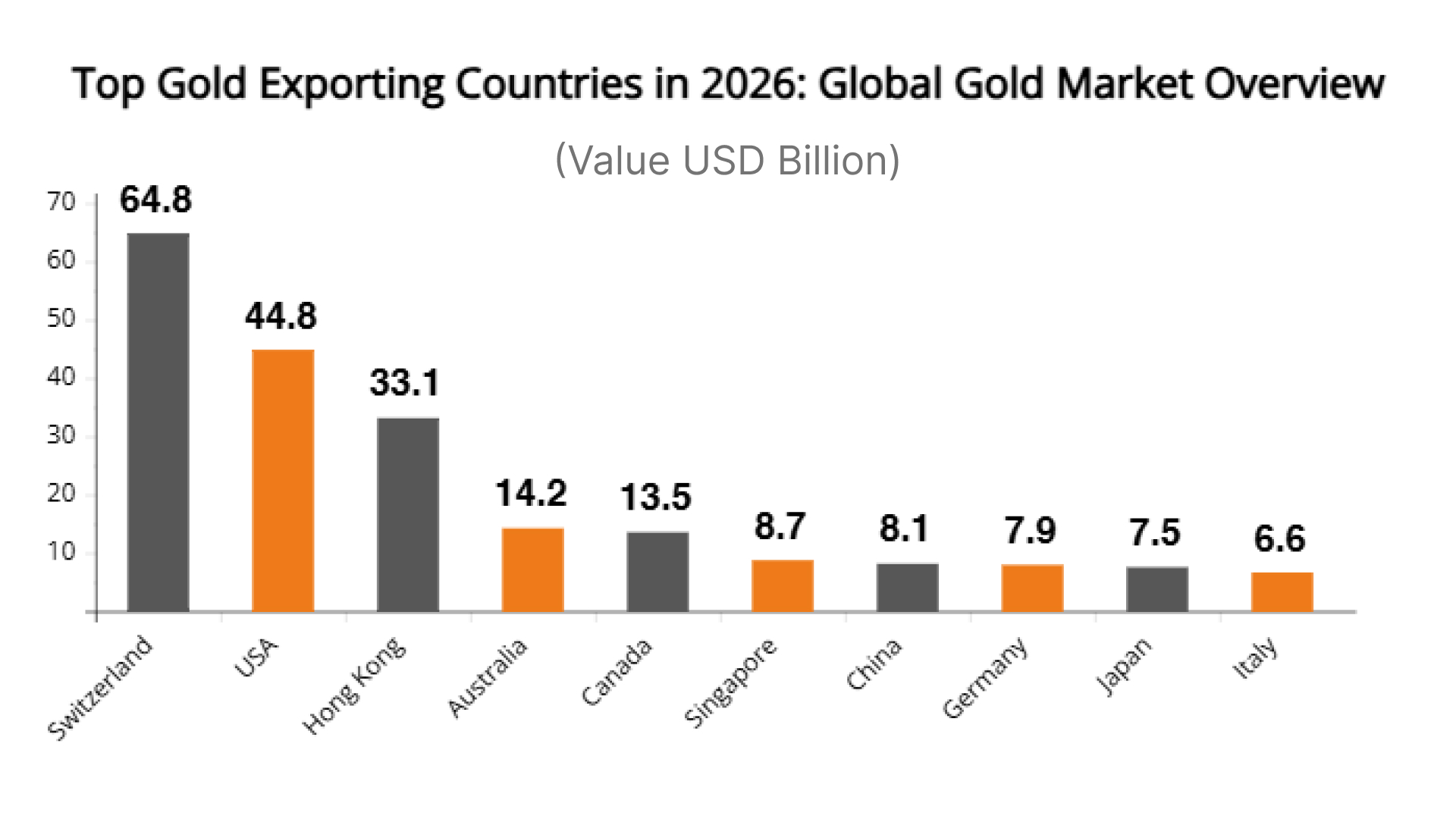
Top Gold Exporting Countries in 2026: Global Gold Market Overview
According to gold export data, global gold exports remain concentrated around 5-6 countries. For instance, Switzerland maintains its long-standing leadership, while North America and Asia continue to strengthen their influence through refining capability, international trading network, and strong financial infrastructure.
Notably, many of these countries do not produce gold directly, but have become hubs for refining, processing, storage, and redistribution across the global markets.
- In 2026, Switzerland remains the world’s largest and undisputed gold exporting country with $64.8 billion. This reflects Switzerland’s decades of expertise in precious metal refining. Further, this reflects how value-added processing often creates greater competitive advantages than mining.
- The United States continues expanding its role as both an exporter and importer of gold. In 2026, the US exported $44.8 B worth of gold globally.
- Notably, Hong Kong, China, and Japan collectively represent the growing importance of Asia in previous metal trade.
For exporters and manufacturers, identifying countries that consistently rank among leading gold exporters provides valuable intelligence for supplier discovery, strategic sourcing, and partnership development. With such intelligence, companies can reduce procurement risk, diversify supply chains, benchmark competitors, and identify reliable trading partners.
| Rank | Country | Trade Value (US$ Billion) |
|---|---|---|
| 1 | Switzerland | 64.8 |
| 2 | USA | 44.8 |
| 3 | Hong Kong | 33.1 |
| 4 | Australia | 14.2 |
| 5 | Canada | 13.5 |
| 6 | Singapore | 8.7 |
| 7 | China | 8.1 |
| 8 | Germany | 7.9 |
| 9 | Japan | 7.5 |
| 10 | Italy | 6.6 |
Global Gold Export Trend: Market Snapshot from 2023 to 2025
According to global gold export data from 2023 to 2025, the market shows more than steady growth; it reflects rapidly increasing global demand despite economic uncertainty. Over the years, every leading gold exporter recorded sustained growth. This points toward a broad-based market expansion rather than isolated regional growth. Here are the top insights –
- Switzerland experienced a significant export growth of $89.6 B, or 83.5% in gold, from 2023 to 2025. This positioned Switzerland as the world’s premier gold-refining and exporting hub.
- UAE emerged as the leading gold exporter in 2025 with $114.1 B, an increase of $63.1 B from 2023. UAE’s strategic geographic location and business-friendly trade environment attract international precious metals trade.
- The USA experienced the fastest growth trajectory among leading gold exporters, with 209.4% from 2023 to 2025, or an increase of $54.5. This rapid acceleration signals stronger international competitiveness and growing participation in global gold markets.
- Hong Kong’s consistent export growth demonstrates its critical position in facilitating gold flows between Asian demand centers and global suppliers despite changing geopolitical conditions.
- Australia, Canada, the UK, and other leading gold exporters all recorded double-digit growth. This indicates sustained global confidence in gold as both an investment asset and industrial commodity.
Historical export trends present businesses with actionable intelligence beyond simple rankings. Companies can identify fast-growing supplier markets, forecast future availability, procurement strategies, and prioritise markets demonstrating consistent long-term export momentum rather than short-term performance.
View Gold Buyers →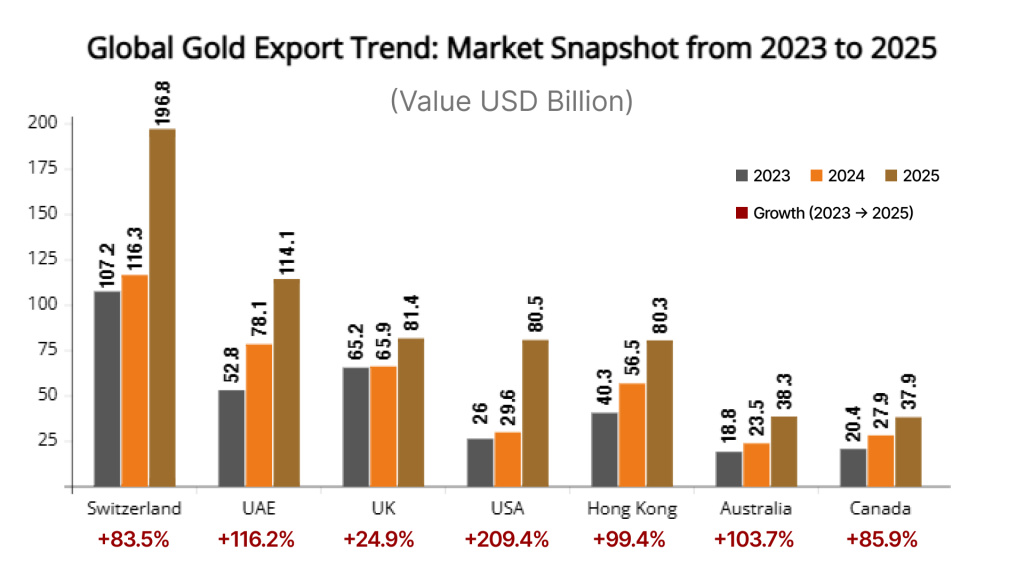
| Country | 2023 | 2024 | 2025 | Growth (2023 → 2025) |
|---|---|---|---|---|
| Switzerland | 107.2 | 116.3 | 196.8 | +83.5% |
| UAE | 52.8 | 78.1 | 114.1 | +116.2% |
| UK | 65.2 | 65.9 | 81.4 | +24.9% |
| USA | 26.0 | 29.6 | 80.5 | +209.4% |
| Hong Kong | 40.3 | 56.5 | 80.3 | +99.4% |
| Australia | 18.8 | 23.5 | 38.3 | +103.7% |
| Canada | 20.4 | 27.9 | 37.9 | +85.9% |
Analysis of both the 2026 gold export ranking and 2023-2025 export trends
When analyzing both the 2026 gold export ranking and 2023-2025 export trends reveals a broader transformation within the global gold market. The above evaluation underscores an important lesson for businesses: success in international trade is no longer driven solely by natural resources. Countries that combine efficient infrastructure, financial expertise, advanced refining capabilities, and strategic geographic positioning are becoming the primary gateways for global gold commerce.
The gold export market analysis provides only one side of the global gold trade equation. To understand where business opportunities truly exist, it is equally important to understand gold import markets.
Rising gold import signals towards consumer demand, expanding jewelry industries, stronger investment activity, and developing manufacturing sectors. Together with gold export intelligence, import trends provide businesses with a complete view of the global gold supply chain.
Top Gold Importing Countries (2021-2025)
The five-year gold import data highlights how global demand for gold continues to shift toward economies with strong consumer markets. While traditional markets continue importing significant volumes, several emerging economies are steadily increasing their presence, creating new opportunities for exporters worldwide. Below are the top gold importers –
- According to gold trade data, Switzerland is both a top importer and top exporter; this shows its role as a refining and trading pass-through hub rather than an end consumer, with import volume growing 127.9% over the period.
- The UK posted the largest overall gain at 186.8% or $100.4 B in 2025, from 2023. This also signals bullion market activity after a mid-period dip in 2022.
- Over the years, China’s gold imports drastically increased from $47.2 billion in 2021 to $102.2 billion in 2025; this translates into a 116.3% increase in the last five years.
Gold import intelligence enables exporters to identify high-demand markets, prioritize buyer acquisition, evaluate market entry opportunities, and align production with global purchasing trends. Businesses that continuously monitor import behaviour can discover emerging markets before competitors while improving sales strategies, customer targeting, and international expansion planning.
Download Sample Data →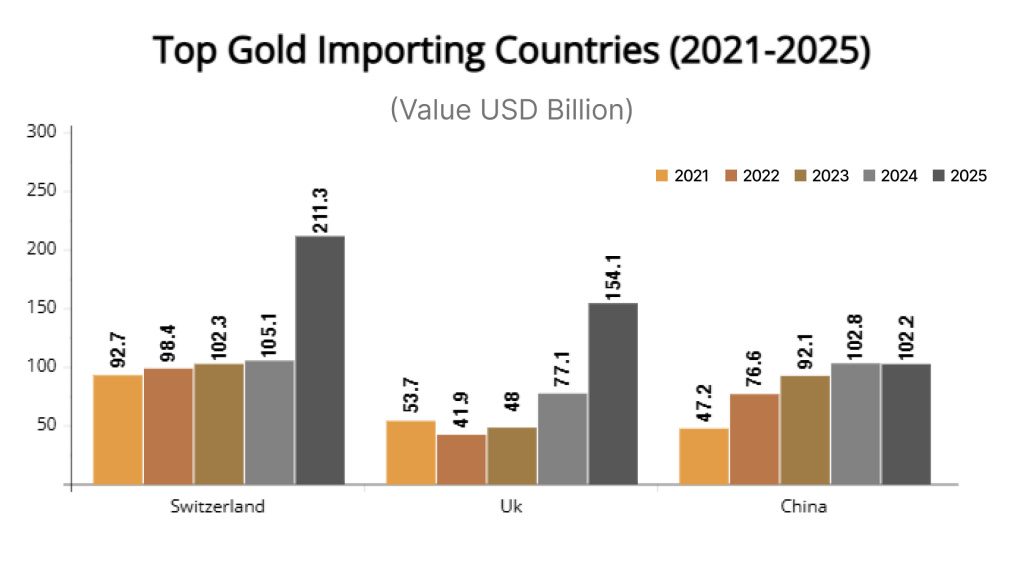
| Country | 2021 | 2022 | 2023 | 2024 | 2025 |
|---|---|---|---|---|---|
| Switzerland | 92.7 | 98.4 | 102.3 | 105.1 | 211.3 |
| UK | 53.7 | 41.9 | 48.0 | 77.1 | 154.1 |
| China | 47.2 | 76.6 | 92.1 | 102.8 | 102.2 |
Value USD Billion
How AI-Powered Trade Intelligence Transforms Business Growth
Over the years, global trade has become more competitive than ever, making access to accurate, trustworthy information and market intelligence significantly more challenging. Having access is a significant competitive advantage.
Nowadays, trade data is no longer useful only for economists or government agencies – it has become an essential strategic resource for businesses of every size.
Businesses can leverage our trade intelligence platform to –
- Discover verified gold suppliers worldwide.
- Identify active importers and potential gold buyers
- Evaluate competitors’ export performance
- Monitor emerging markets
- Optimized sourcing strategies
- Reduce procurement risks with our exclusive risk check
- Strengthen supply chain resilience
- Improve pricing strategies
- Identify expansion opportunities before competitors, etc.
Companies that solely rely on traditional market research often react to market changes after they occur. In contrast, businesses using the Market Inside trade data platform can anticipate demand shifts, identify high-growth regions, and build stronger international partnerships ahead of the market.
As global supply chains continue evolving, trade intelligence is becoming one of the most valuable strategic assets for exporters, manufacturers, distributors, sourcing professionals, and investors.
What is the Future Outlook for the Global Gold Market
According to our gold export and import analysis, the global gold market is expected to remain resilient over the coming years.
Several structural factors are likely to support continued growth –
- Diversification of international gold supply chains
- Strong investment demand across international markets
- Expansion of jewelry consumption
- Growth in electronics manufacturing
- Digital transformation of commodity trading
Countries combining efficient logistics, advanced refining capabilities, transparent regulations, and strong financial ecosystems are expected to strengthen their position within the global gold trade.
Businesses that continuously monitor evolving export and import trends will be better positioned to identify profitable partnerships and capitalize on emerging market opportunities for gold.
FAQs
Which country exports the most gold in the world?
According to the latest trade data, Switzerland remains the world’s largest exporter with $196.6 billion in 2025, supported by its globally recognized refining industry and international trading infrastructure.
Which countries import the most gold?
According to gold import data, Switzerland is the largest importer of gold with $211.3 billion, showing strong jewelry demand and active precious metals markets.
Why is trade intelligence important in the gold industry?
Gold trade intelligence helps businesses identify suppliers, buyers, competitors, evaluate demand, optimize sourcing strategies, and make informed international expansion decisions.
How can exporters use gold trade data?
Exporters can identify high-demand markets, benchmark competitors, and develop more effective global sales strategies.
Why are gold import trends important?
Gold import trends reveal where global demand is growing, helping businesses prioritize markets with the highest potential for long-term expansion.
Conclusion
Gold continues to be one of the world’s most strategically significant traded commodities, connecting mining economies, refining hubs, financial centers, manufacturing, investors, and consumers through a highly interconnected global supply chain.
The combined analysis of export ranking, historical export trends, and long-term import patterns demonstrates that success in international gold trade depends on much more than production capacity.
For businesses, the message is clear. Access to reliable trade intelligence is no longer optional; it is a strategic necessity. Organisations that continuously monitor global trade flows, identify emerging suppliers, and understand buyer behavior will be better equipped to reduce risk. Whether you are an exporter seeking new buyers, an importer evaluating sourcing options, or an investor tracking market dynamics, data-driven intelligence provides the foundation for smarter, faster, and more profitable decisions in the evolving global gold market.
Unlock Global Gold Trade Data
Access verified gold import-export records, discover buyers and suppliers, and track global trade trends—all in one platform.
Explore Gold Trade Data ➜