
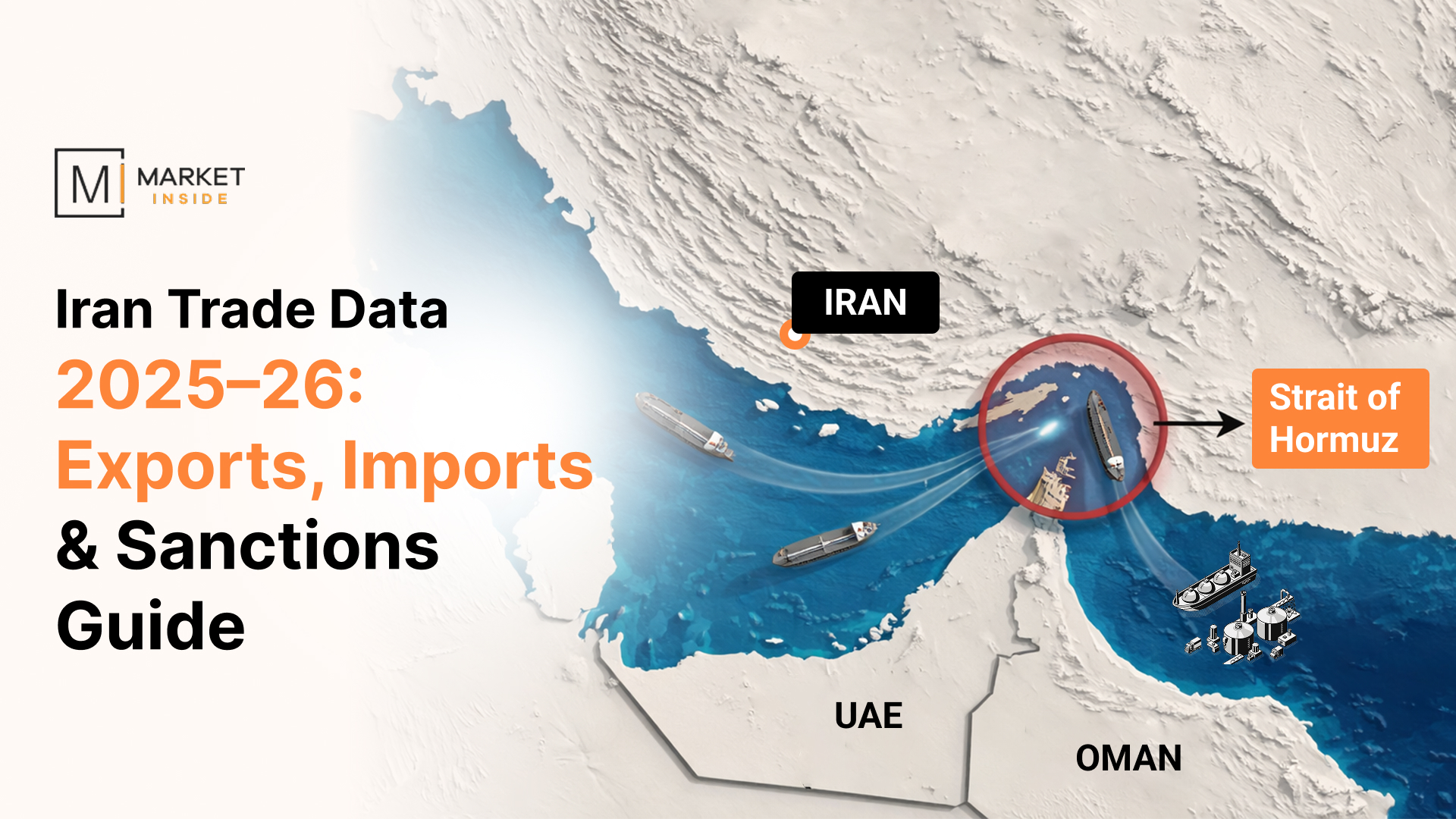
Iran is one of the most strategically located countries near the Strait of Hormuz in this global trade landscape. According to Iran trade data, the country is the 38th largest exporter and the most sanctioned economy worldwide. It also possesses the world’s third-largest oil reserve, accounting for 9% of the global total. Interestingly, Iran produces more saffron than the rest of the world combined. Despite this, Iran’s exports face rotating pressure of international sanctions, currency collapse, and geopolitical alignment.
In 2025, Iran’s total trade value reached $77.9 billion in exports and $89.5 billion in imports, covering gold, maize, machinery, and pharmaceuticals.
The Strait of Hormuz is not just a narrow chokepoint; it is the physical passage through which almost every Iranian product passes. Understanding Iran trade data in 2025 means knowing what has been placed at risk.
Iran Trade Data – An Economy at a Glance
Understanding Iran trade data in 2025 and 2026 requires holding realities in tension at once.
- A resilient, adaptive economy that has consistently expanded its non-oil trade even under international pressure.
- A fragile energy export machine whose primary lifeline is the Strait of Hormuz.
- Iran has partially closed this chokepoint in response to a US-Israel military strike under “Operation Epic Fury.”
What is Iran’s total trade volume? Iran’s total export value reached $77.9 billion, and its imports totalled $89.5 billion, in 2025. Iran’s trade data show that the country’s imports exceed its total exports, resulting in a $11.6 billion trade deficit in the same year.
| Trade Direction 2025 | Trade Value $ Bn | Shipment Number |
| Iran Export | 77.9 B | 1.2 million |
| Iran Import | 89.5 B | 580.7 K |
Source: Market Inside Data
Iran’s Trade Data: Iran’s Top Export Destinations and Import Partners In 2025
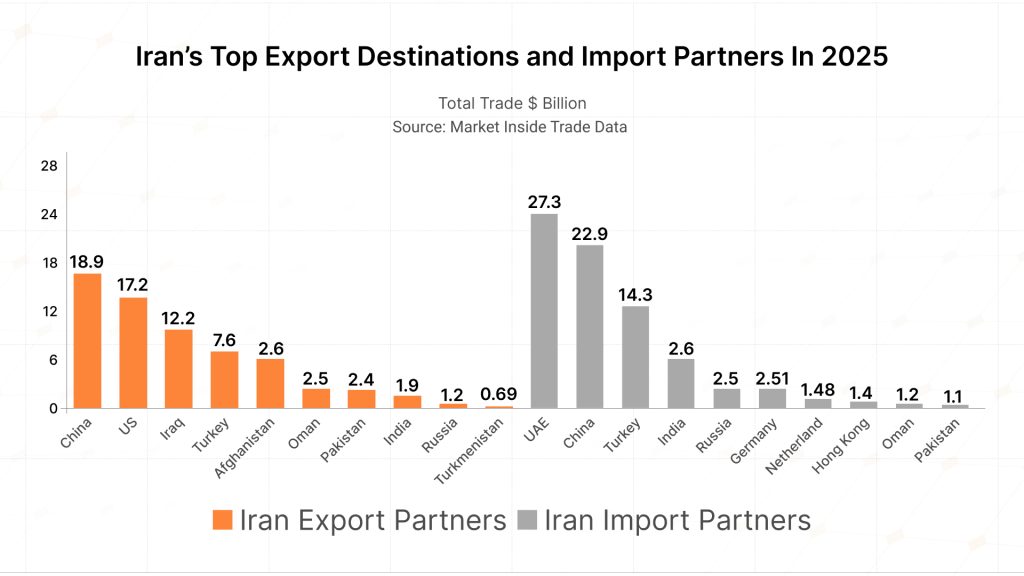
In 2025, Iran’s exports and imports reflect a strong reliance on some strategically important global partners. Countries like China and the United Arab Emirates lead their exports, while Asian suppliers dominates its imports. The table below highlights key markets and global trade.
- China plays a dual dominance in Iran trade, by being Iran’s largest export buyer ($18.9 B) and second largest import supplier ($22.9 B). The current disruption in the Strait of Hormuz is directly affecting Chinese trade interests.
- The UAE’s $27.3 billion in exports to Iran reveals a crucial partner as Iran’s trading window to the world. However, the UAE’s position is itself under threat from the January 2026 US tariff announcement targeting Iran’s trading partners.
- The US appears to be Iran’s second-largest export destination with $17.2 billion despite active sanctions.
| Iran Export Partners | Total Trade $ Billion | Iran Import Partners | Total Trade $ Billion |
| China | 18.9 | UAE | 27.3 |
| US | 17.2 | China | 22.9 |
| Iraq | 12.2 | Turkey | 14.3 |
| Turkey | 7.6 | India | 2.6 |
| Afghanistan | 2.6 | Russia | 2.56 |
| Oman | 2.5 | Germany | 2.51 |
| Pakistan | 2.4 | Netherland | 1.48 |
| India | 1.9 | Hong Kong | 1.4 |
| Russia | 1.2 | Oman | 1.2 |
| Turkmenistan | 0.69 | Pakistan | 1.1 |
Source: Market Inside Data
Iran’s top 3 export destinations – China ($18.9B), the US ($17.2B), and Iraq ($12.2B), together account for approximately 43% of all Iranian exports. The US-Israel-Iran conflict could potentially close the Strait of Hormuz.
Iran’s Crude Oil & Energy Exports – The Strait of Hormuz Dependency
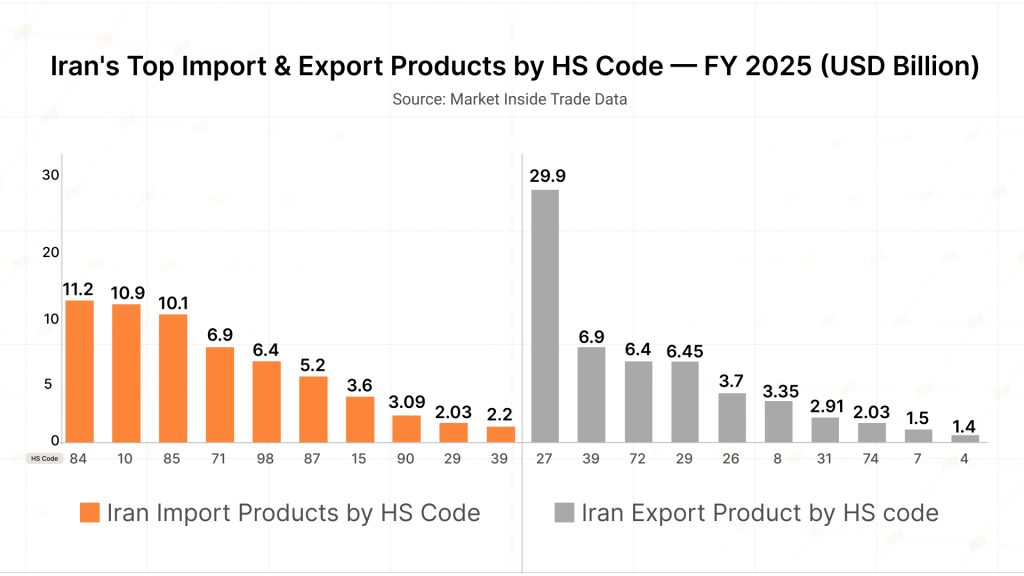
According to Iran Export data, Crude oil and mineral fuels under (27) remains Iran’s single largest export category with $29.9 billion in 2025. This represents more than 25% of the total export value. Further, it highlights Iran’s complete dependency on the Strait of Hormuz, through which more than 90% of Iran’s oil exports pass.
Iran’s top three export products are energy-driven, which account for approximately $43.25 billion or around 40% of the total exports. It also shows that every dollar of this trade is now frozen due to the Strait of Hormuz blockade.
Iran Import and Export Products by HS Code in 2025
The given HS Code composition exposes Iran’s structural dependencies that came to light after the US-Israel military strike against Iran’s critical infrastructure.
- Industrial machinery and electrical equipment, which together represent around $21.3 billion, accounting 30% of all imports. This reflects Iran’s dependency on foreign-sourced goods to maintain its major manufacturing industries.
- Iran’s $10.9 billion cereal import (Maize, wheat, barley, etc.) indicates dependence on food commodities, which is now severely disrupted.
- Iran’s $6.9 billion in gold imports is the fourth largest import category. The government brought this gold as a reserve to mitigate the impact of SWIFT exclusion.
Iran’s HS 27 exports (crude oil, $29.9B) alone exceed the combined value of its next four export categories. This single commodity dependence is among the most affected by potential disruption at the Strait of Hormuz.
| Iran Import Products by HS Code | Import Value $ Bn | Iran Export Product by HS code | Export Value $ Bn |
| 84 | 11.2 | 27 | 29.9 |
| 10 | 10.9 | 39 | 6.9 |
| 85 | 10.1 | 72 | 6.4 |
| 71 | 6.9 | 29 | 6.45 |
| 98 | 6.4 | 26 | 3.7 |
| 87 | 5.2 | 8 | 3.35 |
| 15 | 3.6 | 31 | 2.91 |
| 90 | 3.09 | 74 | 2.03 |
| 29 | 2.3 | 7 | 1.5 |
| 39 | 2.2 | 4 | 1.4 |
Source: Market Inside Data
Iran Port Intelligence – Loading & Unloading Data 2025
Over the years, Iran’s port infrastructure has played a crucial role as a physical backbone of its entire economy. The Iran port intelligence data reveals which terminals handle the most trade value, and which are now most affected by the US-Israel-Iran conflict.
On the import side, Shahid Rajaee Special Economic Area received the majority of Iranian goods worth $23.9 billion in 2025. This single facility makes it one of the most commercially significant ports in the Middle East by trade value.
On the export side, the Pars special economic zone serves as the main terminal for Iran’s petrochemical and gas exports. This terminal holds the the world’s largest gas reservoir shared with Qatar.
Notably, all five Iranian port facilities combined handle over $62 billion in annual trade, and transit via the Strait of Hormuz.
Chabahar: One Iranian Port That Bypasses the Strait of Hormuz
The Chabahar port is the only major Iranian port located on the Gulf of Oman, entirely outside the Strait of Hormuz. The Indian government funded the Chabahar Shahid Beheshti terminal to gain a direct access route to Afghanistan and Central Asia.
This Chabahar port receives goods from Pakistan, India, and Central Asian transit cargo without needing to navigate the strait at all.
Since the Strait of Hormuz blockade, Chabahar port has become strategically important, as it is Iran’s only functioning major sea-facing import gateway.
Image: Iran Port Intelligence: Iran Port of Loading and Unloading Data in 2025
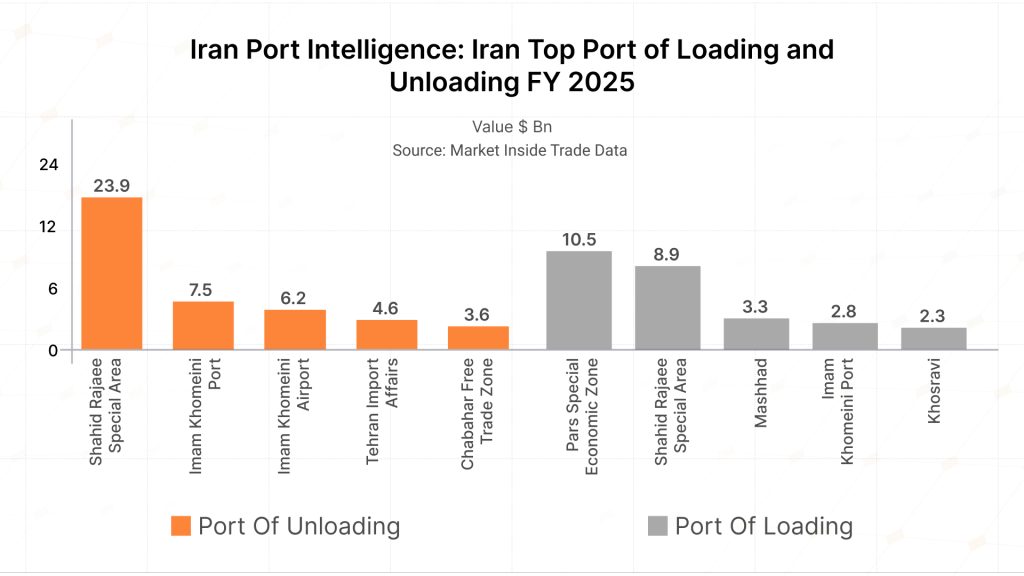
| Port Of Unloading | Value $Bn | Port Of Loading | Value $ Bn |
| Shahid Rajaee Special Area | 23.9 | Pars Special Economic Zone | 10.5 |
| Imam Khomeini Port | 7.5 | Shahid Rajaee Special Area | 8.9 |
| Imam Khomeini Airport | 6.2 | Mashhad | 3.3 |
| Tehran Import Affairs | 4.6 | Imam Khomeini Port | 2.8 |
| Chabahar Free Trade Zone | 3.6 | Khosravi | 2.3 |
Iran’s Top Exporting Companies in 2025
Behind Iran’s massive $112.6 billion export economy, only a small number of dominant corporations play a major role. Almost all the Iranian exporting companies are state-owned energy giants. And all of these deal in the oil, gas, and petrochemical sectors, and disruption at the Strait of Hormuz – affecting commercial operations.
The table below provides insights into Iranian export companies, highlights their trade activity, and shipment records.
Iran’s top 5 exporters collectively exported $19.2 billion in trade value across 4,043 shipments in 2025. And on average, $16.8 billion is now affected by disruption at the Strait of Hormuz.
Image: Iran’s top Exporters in 2025
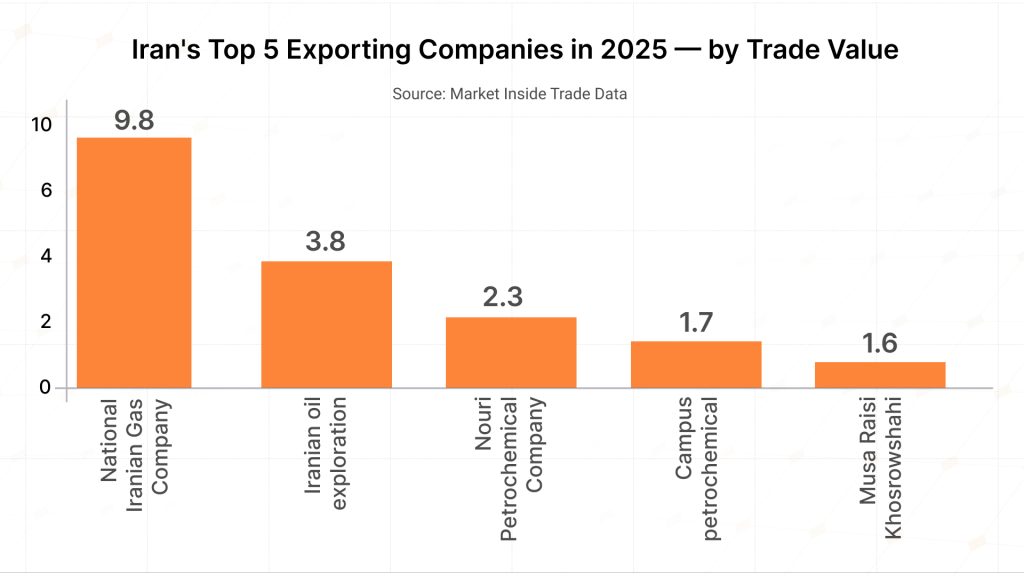
| Exporters | Trade Value | Total Shipments |
| National Iranian Gas Company | 9.8 | 1455 |
| Iranian oil exploration | 3.8 | 164 |
| Nouri Petrochemical Company | 2.3 | 236 |
| Campus petrochemical | 1.7 | 121 |
| Musa Raisi Khosrowshahi | 1.6 | 2067 |
Source: Market Inside Data
What is the Strait of Hormuz, And Why Does It Matter?
The Strait of Hormuz is a 54 km wide narrow sea passage separating Iran from the Arabian Peninsula, connecting the Persian Gulf to the Gulf of Oman. Interestingly, this tiny corridor handles 20 million barrels per day (mb/d) of crude oil and oil products shipped in 2025. This represents approximately 25% of the world’s seaborne oil trade.
The countries that depend on the Strait are the heart of the global oil supply: Saudi Arabia, Iran, Iraq, Kuwait, Qatar, and Bahrain. Only Saudi Arabia and the UAE possess limited alternative pipeline routes. Any disruption signals a global energy crisis.
A Snapshot of Global Energy Dependency
As per the IEA’s latest available data on crude oil, petroleum products, and gas flows that pass via the Strait of Hormuz are –
- Saudi Arabia and Iraq are the largest exporters with 6.23 and 3.63 mb/d through the Strait.
- Nearly 15 mb/d of crude oil, around 34% of the global crude oil trade, passed through in 2025 alone.
- China and India together import approximately 34% of all crude oil transiting via the Strait. Asia as a whole is the destination for 80% of these flows.
LNG Dimension – A Threat Beyond Oil
The Strait of Hormuz plays a crucial role in LNG transport. Qatar, the world’s second-largest LNG exporter, shipped over 112 billion cubic meters (bcm) of LNG in 2025. Both the UAE and Qatar export nearly 20% of the global LNG trade, with no alternative routes available.
As the US-Israel-Iran conflict disrupts trade via the Strait of Hormuz, it could potentially affect 300 million cubic meters per day from the global LNG supply. The price spike would be immediate and felt across Asia and Europe.
Can the World Bypass the Strait? The Hard Truth About Alternative Routes
The honest answer is not nearly enough. Available bypass capacity is estimated at just 3.5 to 5.5 mb/d, a fraction of the 20 mb/d that transits the strait daily. The alternative includes –
- Saudi Arabia’s Petroline (the Abquaiq-Yanbu East-West Crude Pipeline) offers the most meaningful alternative. The reported capacity is 7 mb/d as of March, but roughly 2 mb/d is currently in use.
- The UAE’s Abu Dhabi Crude Oil Pipeline (ADCOP) offers up to 700 kb/d capacity.
- For natural gas, there are no alternative export routes.
Conclusion –
Iran’s trade data for 2025 is not only an overview of Iran’s top export destinations, import partners, HS code breakdown, and port intelligence. It’s the comprehensive market insights on what has been placed at risk by the US-Israel joint operation and the Strait of Hormuz Consequences.
The Strait of Hormuz has always been described as the heart of the Middle East. The statistical insights on this narrow chokepoint make the economic reality concrete, measurable, and actionable for researchers, policymakers, and businesses across the globe.
The world has faced an oil shortage before. The 1973 embargo accelerated nuclear power in France. The 1979 Iranian revolution drove Japan’s energy-efficiency revolution. Whether the 2026 Hormuz crisis becomes the catalyst for the next great transition remains the defining geopolitical and economic question of our time.
FAQ – Iran Trade Data and Strait of Hormuz Crisis
What is Iran’s biggest export in 2025?
Iran’s largest export is crude oil and mineral fuels (HS27), valued at $29.9 billion in 2025, which accounts for about 26% of total exports. The second largest is petrochemical polymers (HS 39) at $6.9B, followed by organic chemicals (HS 29) at $6.45B.
Who is Iran’s largest export destination in 2025?
China is Iran’s largest export destination at $18.9 billion. The US follows at $17.2 billion (largely through indirect re-export channels via the UAE and Turkey), and Iraq is third at $12.2 billion. Together, these three countries receive over 43% of all Iranian exports.
Which country exports the most to Iran?
The UAE is Iran’s largest import supplier at $27.3 billion. China follows at $22.9 billion, and Turkey is third at $14.3 billion. Together, these three countries supply over 88% of Iran’s total imports.
What Is Iran Trade Data?
Iran trade data records the country’s exports and imports of goods and services. In 2025, Iran’s total exports reached $77.9 billion while imports stood at $89.5 billion, resulting in a trade deficit of $11.6 billion.
What is Iran’s busiest port for imports?
Shahid Rajaee Special Economic Area is Iran’s busiest import port at $23.9 billion — by a substantial margin over the second-ranked Imam Khomeini Port ($7.5B). Shahid Rajaee sits directly on the Strait of Hormuz at Bandar Abbas and is now severely disrupted by the 2026 blockade. Chabahar Free Trade Zone ($3.6B) is currently the only major Iranian port operating near normally, as it is located outside the Strait.
Which Iranian export products are now blocked by the Hormuz closure?
Virtually all of Iran’s marine-exported goods are now blocked: crude oil (HS 27, $29.9B), petrochemicals (HS 39, $6.9B), chemicals (HS 29, $6.45B), iron and steel (HS 72, $6.4B), iron ore (HS 26, $3.7B), and fertilizers (HS 31, $2.91B). Only agricultural goods moving by air (pistachios, saffron — approximately $1.5B annually) and pipeline gas to Iraq and Turkey continue at reduced capacity.
The Strait of Hormuz Blockade Changed Everything. See the Data
Unlock Iran oil exports, port disruption, and shifting trade routes – Updated as the crisis evolves
Get your market now – Click