
Malaysia, a bustling, vibrant, and growing nation of Southeast Asia, has made itself one of the most notable commercial countries in the world. It is a global powerhouse in semiconductors, electronics manufacturing, industrial machinery, and commodity commerce, serving as a vital gateway that connects Asia-Pacific markets to the rest of the globe. The country is integrated in world supply chains, providing high-value products to large markets in Asia, North America, Europe, and the Middle East.
Overview of Malaysia’s Trade Imports and Exports
According to OEC, Malaysia’s trade data highlights export growth across major markets, with integrated circuits emerging as the country’s strongest-performing export segment, reinforcing its status as a key manufacturing and export hub in Asia.
- With whom does Malaysia share its imports?
- Where does it export to?
- Who are all the buyers and suppliers in the global market?
Everything you need to know about Malaysia’s imports and exports is available in here. Let us understand the true market curve for Malaysia with real trade data and trend analysis and see the future aspects of it!
Top 10 Destinations for Malaysia’s Exports
Malaysia has a diversified export portfolio and exports to many regions around the world. Singapore, the United States, and China continue to be Malaysia’s most important export destinations. This signals the country’s importance in regional and global supply chains.
| Countries | 2021 | 2022 | 2023 | 2024 | 2025 |
| Singapore | 41.856 | 52.928 | 48.142 | 50.537 | 58.304 |
| United States | 34.373 | 38.076 | 35.492 | 43.513 | 54.446 |
| China | 46.361 | 47.935 | 42.196 | 41.082 | 44.131 |
| Hong Kong, China | 18.498 | 21.756 | 19.722 | 19.447 | 22.484 |
| Chinese Taipei | 9.786 | 11.765 | 9.504 | 14.664 | 20.548 |
| Japan | 18.17 | 22.358 | 18.813 | 18.085 | 17.844 |
| Thailand | 12.649 | 14.985 | 12.886 | 12.912 | 14.969 |
| Vietnam | 10.984 | 12.211 | 11.418 | 11.79 | 12.907 |
| South Korea | 9.089 | 12.467 | 12.267 | 11.811 | 12.293 |
| Indonesia | 9.467 | 12.757 | 11.175 | 11.909 | 11.963 |
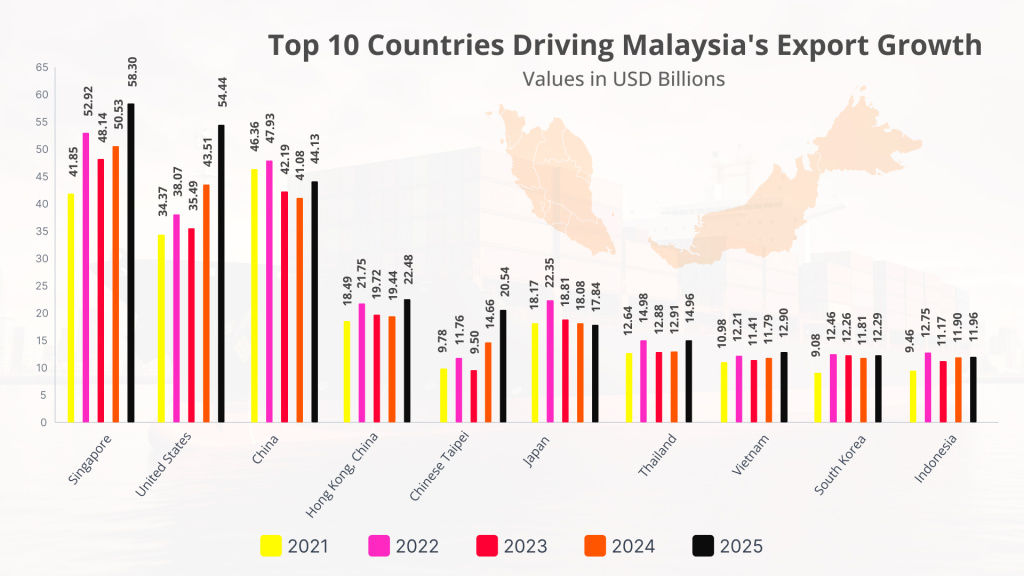
Singapore is Malaysia’s biggest export destination, and exports to the city-state increased from around US$41.8 billion to US$58.3 billion over time.
“Singapore is not just a neighboring market; it is a major regional trade and logistics hub that helps Malaysian products reach customers across the globe.”
The United States is one of Malaysia’s fastest-growing export markets. Exports jumped to US$54.4 billion, buoyed by robust demand for semiconductors, electronic components, machinery, and other high-value manufactured goods. Malaysia is becoming an increasingly important supplier to the U.S. market with the growth of global technology supply chains.
China is the cornerstone of Malaysia’s export economy, importing more than US$40 billion of commodities each year. The commercial connection is about much more than trade volumes; it is about deep integration of the two countries in regional industry and supply chain networks.
The most interesting trend in data suggests the expansion of exports to Chinese Taipei (Taiwan). Export values more than doubled throughout the time, mostly driven by higher demand for semiconductor-related items and electronic components. Meanwhile, Hong Kong is still an important gateway to Greater China, and it still plays an important part in the flow of regional trade.
Closer to home, Malaysia’s exports are finding markets in Thailand, Vietnam, and Indonesia. Trade inside ASEAN is increasing, reflecting how intertwined Southeast Asia’s economies are, with companies increasingly reliant on regional supply chains and cross-border manufacturing networks.
Top 10 Export Products of Malaysia
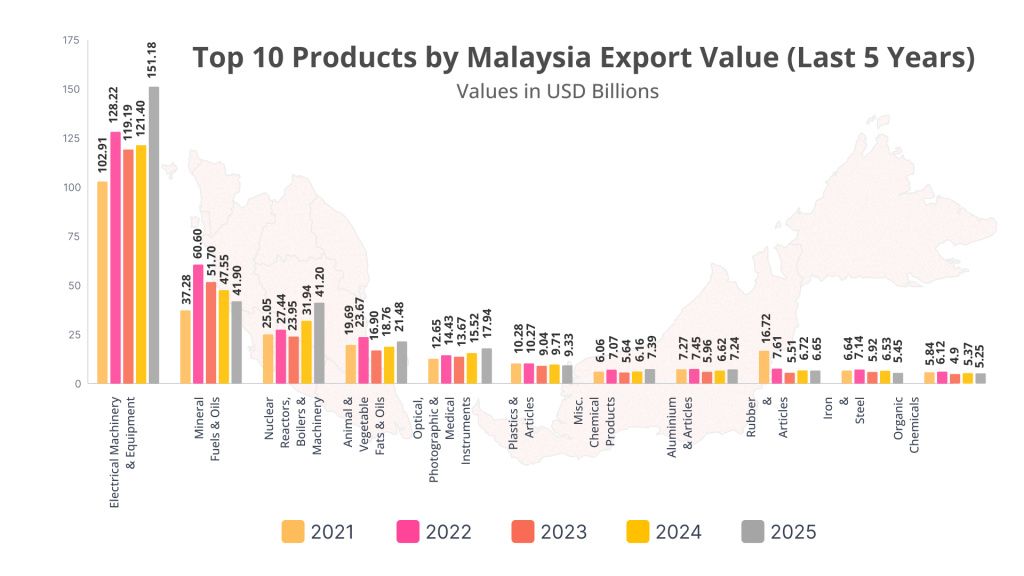
A mix of high-tech manufacturing, industrial items, energy commodities, and agricultural exports drives Malaysia’s export performance. Together, these sectors contributed more than US$375 billion in export value in 2025, reaffirming Malaysia as one of Asia’s most trade-oriented countries.
| Commodities | 2021 | 2022 | 2023 | 2024 | 2025 |
| Electrical Machinery & Equipment | 102.91 | 128.22 | 119.19 | 121.4 | 151.18 |
| Mineral Fuels & Oils | 37.28 | 60.6 | 51.7 | 47.55 | 41.9 |
| Nuclear Reactors, Boilers & Machinery | 25.05 | 27.44 | 23.95 | 31.94 | 41.2 |
| Animal & Vegetable Fats & Oils | 19.69 | 23.67 | 16.9 | 18.76 | 21.48 |
| Optical, Photographic & Medical Instruments | 12.65 | 14.43 | 13.67 | 15.52 | 17.94 |
| Plastics & Articles | 10.28 | 10.27 | 9.04 | 9.71 | 9.33 |
| Mis. Chemical Products | 6.06 | 7.07 | 5.64 | 6.16 | 7.39 |
| Aluminium & Articles | 7.27 | 7.45 | 5.96 | 6.62 | 7.24 |
| Rubber & Articles | 16.72 | 7.61 | 5.51 | 6.72 | 6.65 |
| Iron & Steel | 6.64 | 7.14 | 5.92 | 6.53 | 5.45 |
| Organic Chemicals | 5.84 | 6.12 | 4.9 | 5.37 | 5.25 |
Electrical Machines & Apparatus
The electronics industry is one of the main contributors to the strong performance of Malaysia’s exports. The highest export sector was electrical machinery & equipment. It represented more than 40% of total Malaysian exports (US$151.18 billion) in 2025. Malaysia plays a crucial role in the global semiconductor supply chain, providing key components to major tech hubs in the US, China, Singapore, Taiwan, and Europe.
Fuels, Mineral Oils
As the globe moves towards greener energy, fuels remain a significant part of international trade. Mineral fuels & oils were Malaysia’s second-largest export sector in 2025, with shipments worth US $41.90 billion. Notwithstanding the volatility of global energy prices, refined petroleum products, crude oil, and associated commodities are vital factors to Malaysia’s trade performance.
Nuclear Reactors, Boilers, Machinery
Every factory, manufacturing line, or industrial enterprise needs machines. Malaysia’s industrial expertise has been growing, and exports of nuclear reactors, boilers, and machinery reached US$41.20 billion in 2025. This category contains industrial machinery, mechanical devices, manufacturing equipment, and production components used in numerous industries. The sector’s growth underscores Malaysia’s economy as it transitions from commodities to high-value industrial manufacturing.
Fats and oils, Animal or vegetable
Palm oil is still the main reason Malaysia is one of the world’s leading makers of edible oils and palm-based goods. Animal & vegetable fats & oils exports in 2025: US$21.48 billion. Palm oil is still the main reason Malaysia is one of the world’s leading makers of edible oils and palm-based goods. Palm oil has numerous uses apart from food uses; it is utilized in cosmetics, biofuels, personal care products, etc.
Optical, Photographic and Medical Instruments
Malaysia is changing from traditional manufacturing to high-value precision sectors. Exports of optical, photographic, & medical instruments in 2025: US$17.94 billion. The country has expanded its footprint in medical devices, research instruments, diagnostic equipment, and precision technology. Its growing role in healthcare manufacturing gives rise to Malaysia’s capability to rise up the global value chain.
Articles and plastics
Plastics find extensive use in numerous industries worldwide, including packaging, healthcare, electronics, and vehicles. Exports of plastic products were at US$9.33 billion in 2025. They are used in packaging, automotive manufacturing, healthcare, electronics, and consumer goods manufacturing.
Other chemical products
In the wings chemicals are produced, which are the base of many things we use every day. Miscellaneous chemical product exports in Malaysia were US$7.39B in 2025. These exports support a wide range of businesses, from agriculture to health care to manufacturing and consumer goods. It remains competitive in chemical production because of its strong industrial base and proximity to major Asian manufacturing hubs.
Aluminium & Articles
In 2025, exports of aluminum and aluminum-based products amounted to US$7.24 billion. Aluminum is widely used in construction, transportation, aircraft, packaging, and industrial manufacturing and is a significant part of Malaysia’s export portfolio.
Rubber and Goods
Malaysia has built its position as a global rubber leader over decades. Rubber and rubber products exports were valued at US$6.65 billion in 2025. Exports include a variety of products ranging from medical gloves and automotive parts to industrial rubber goods. Although exports’ value has seen fluctuations of late, the industry remains vitally important to Malaysia’s economy and manufacturing ecosystem.
Iron and Steel
Steel is the beginning of every building, every industrial endeavor, every infrastructural project. Iron and steel exports in 2025 amounted to US$5.45 billion. These commodities are used to facilitate building and infrastructure development and industrial manufacturing activities around the globe.
Organic Chemicals
Organic substances form the backbone of modern manufacturing. They are often out of the sight of customers. The export value of organic chemicals was US$5.25 billion in 2025. These chemicals are significant inputs for medicines, plastics, textiles, consumer items, and industrial manufacture. Malaysia has a well-developed chemical manufacturing ecosystem and is well-placed to gain from the rising regional and global demand in the years ahead.
How to Access Malaysia’s Trade Data and Spot the Next Best Opportunity?
Finding new trade opportunities starts with reliable market intelligence. The Market Inside Dashboard provides access to trade data from 190+ countries, empowering exporters, importers, manufacturers, and market analysts to make informed decisions with confidence.
The platform offers comprehensive import-export insights, enabling businesses to analyze Malaysia’s trade performance and compare it with global markets. Whether you’re identifying new buyers, evaluating suppliers, or tracking industry trends, the dashboard delivers the data needed to uncover growth opportunities.
Key Features
- Trade data for 190+ countries across global markets.
- Product and HS code search for detailed commodity-level analysis.
- Import and export statistics by country, product, and year.
- Top importing and exporting countries for each product.
- Historical trade trends to analyze market growth.
- Demand and supply analysis to identify high-potential markets.
- Market share insights to benchmark leading exporters and importers.
- Buyer and supplier discovery for expanding global trade networks.
Five Years of Malaysia’s Trade Growth
As global supply chains shifted and demand for technology surged, Malaysia is now considered as a preferred destination for manufacturing, investment, and international trade. Here are some of the key trends shaping the trade success for Malaysia!
High-Demand for Electronics
The country remained a key global technological supply chain as the world’s demand for semiconductors, integrated circuits, and digital technologies soared. The booming AI, cloud computing, and smart devices have bolstered demand for Malaysia’s electronics exports.
Benefit from Supply Chain Shift
Many firms are focusing on Malaysia to reduce reliance on a single production base. Its strategic position, solid infrastructure, and qualified people offered corporations an enticing option to diversify and build more resilient supply chain networks.
The Rise of High-Tech Manufacturing
Malaysia is climbing the value chain. Increased investments in semiconductor manufacture, advanced manufacturing, automation, and Industry 4.0 technologies have enhanced the country’s standing in high-tech manufacturing and set the stage for future growth.
In a Nutshell
Over the last five years, Malaysia’s export landscape has shown promising progress. A strong demand for electronics, rising investment in high-tech manufacturing, diversification of the supply chain, and increased regional trade integration have driven Malaysia’s prosperity. With the continued search for reputable manufacturing and sourcing destinations, Malaysia is well placed to strengthen its position as a leading trade and technology hub in Asia.
What does Malaysia import the most?
Malaysia imports a wide variety of products to serve its manufacturing and consumer sectors. The country imports some of the world’s largest amounts of semiconductors, electronic parts, industrial machinery, chemicals, petroleum products, plastics, cars, medical equipment, and iron and steel products.
What are the main exports from Malaysia?
The main exports from Malaysia include electronics, semiconductors, palm oil, petroleum products, machinery, chemical products, etc. These industries are key components to the country’s export growth and global trade footprint.
How to Find Exporters and Importers in Malaysia?
You can find the total number of exporters and importers in Malaysia using the Market Inside Trade Intelligence Platform. You can also analyze their complete list of trade activities, explore shipment records, and discover potential buyers and suppliers.
How to get Malaysian customs data?
With the help of the Market Inside Trade Intelligence Platform, you can easily discover Malaysia customs data. Obtain shipment-level information, import-export statistics, and buyer-supplier intelligence.
How can businesses use Malaysian trade data?
Trade data help businesses make better judgments. Whether you seek new buyers or suppliers or keep an eye on competition, sophisticated trade systems like Market Inside provide vital data to boost your business success.
Future Market Opportunities in Malaysia: What is its growth potential?
Malaysia is well placed to tap the next wave of global trade and investment, especially in semiconductors, artificial intelligence (AI), data centers, sophisticated manufacturing, and digital services. The country’s electronics sector already accounts for close to 37% of overall exports, while robust worldwide demand for AI infrastructure and semiconductor components continues to attract substantial international investment.