
In recent years, green trade policies and regulations that incorporate environmental criteria into international trade have emerged as a major force shaping global exports. By prioritizing low-carbon production, carbon pricing, and environmental compliance, countries and blocs are shifting the rules of competition. Policies such as the European Union’s Carbon Border Adjustment Mechanism (CBAM) and evolving climate standards are redefining cost structures, supply chains, and export competitiveness. These policies intend to reduce global emissions, but they also carry significant trade and economic implications. Market Inside helps you understand connection between green trade policies and global imports and exports.
What Are Green Trade Policies?
Green trade policies integrate environmental concerns into trade rules and practices. They include:
- Carbon Border Adjustments (tariffs on carbon-intensive imports)
- Environmental standards and due diligence
- Subsidies for green goods and technologies
- Trade facilitation for environmental products
These measures aim to reduce carbon leakage (production shifting to countries with lax climate laws) and incentivize cleaner production globally.
Major Example: EU’s Carbon Border Adjustment Mechanism (CBAM)
The EU has pioneered one of the most ambitious green trade policies — the Carbon Border Adjustment Mechanism (CBAM) — which:
- Penalizes imports of carbon-intensive goods (like steel, cement, aluminum, and fertilizers) based on their CO₂ footprint.
- Requires importers to pay for emissions embedded in their products starting 2026.
- Initially covers around 303 products but could expand to cover an additional €55 billion worth of goods by the late 2020s.
This policy is designed to level the playing field between EU-based producers — who pay carbon costs under the EU emissions trading system — and foreign competitors that do not face similar regulations.
Estimated Economic Impact
According to reports, CBAM could generate up to $80+ billion per year by 2040 from carbon pricing levies on imports.
Early estimates indicate that countries exporting heavy industrial products to the EU such as China, India, and Turkey; will bear a significant share of CBAM obligations due to carbon-intensive production.
Impact on Export Flows & Competitiveness
Exporters in Carbon-Intensive Sectors
Countries that rely on exporting carbon-intensive goods are facing higher trade costs under CBAM and similar policies:
India’s steel and aluminum exports to the EU, worth billions are expected to carry an additional carbon levy, potentially increasing export costs by an average of ~25% on close to 10% of its exports to the EU.
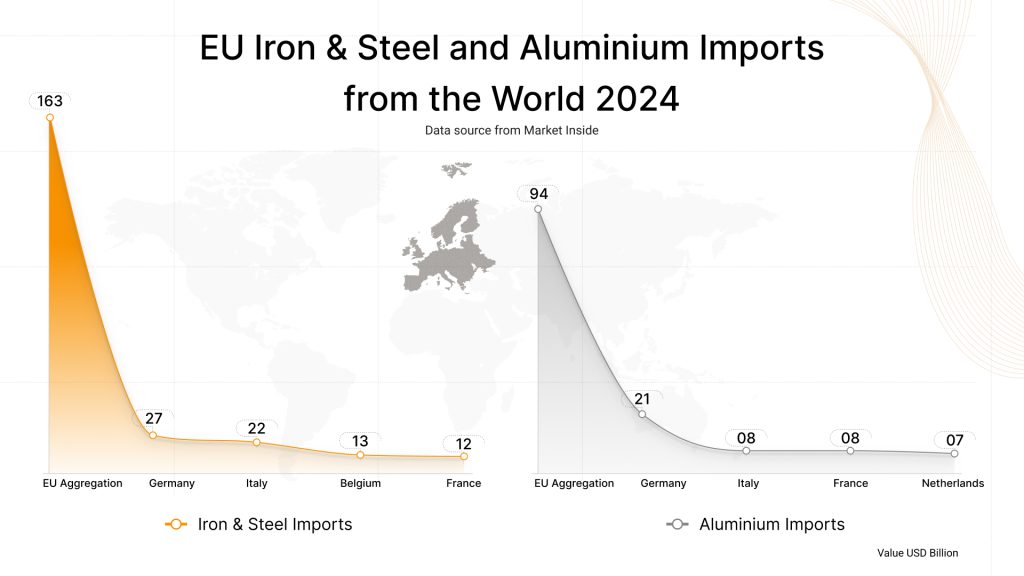
| Country | Iron & Steel Imports | Country | Aluminium Imports |
| EU Aggregation | 163 | EU Aggregation | 94 |
| Germany | 27 | Germany | 21 |
| Italy | 22 | Italy | 8 |
| Belgium | 13 | France | 8 |
| France | 12 | Netherlands | 7 |
******Value USD Billion
Korean exporters have established government units specifically to navigate CBAM compliance due to potential levies on steel, cement, and aluminum exports.
Developing Countries’ Export Exposure
The World Bank’s CBAM Exposure Index shows that countries heavily dependent on exporting carbon-intensive goods to Europe are particularly vulnerable. This includes economies whose export competitiveness is tied to traditional industries like metals and chemicals.
- Green Goods and Export Growth Opportunities
- Rise in Environmental Goods Exports
Some countries have capitalized on green trade opportunities:
China’s exports of clean technologies including solar panels, EVs, and batteries have surged. Emerging markets accounted for 43% of China’s clean tech exports in 2024, more than double the share from 2022, reflecting demand for affordable green technologies.
This shift underscores how green trade policies can redirect global trade towards low-carbon products. Following HS Codes are taken for the stats:
- Solar Panels:
- EVs: HS Code 8703, HS Code 8702, HS Code 8704, HS Code 8711
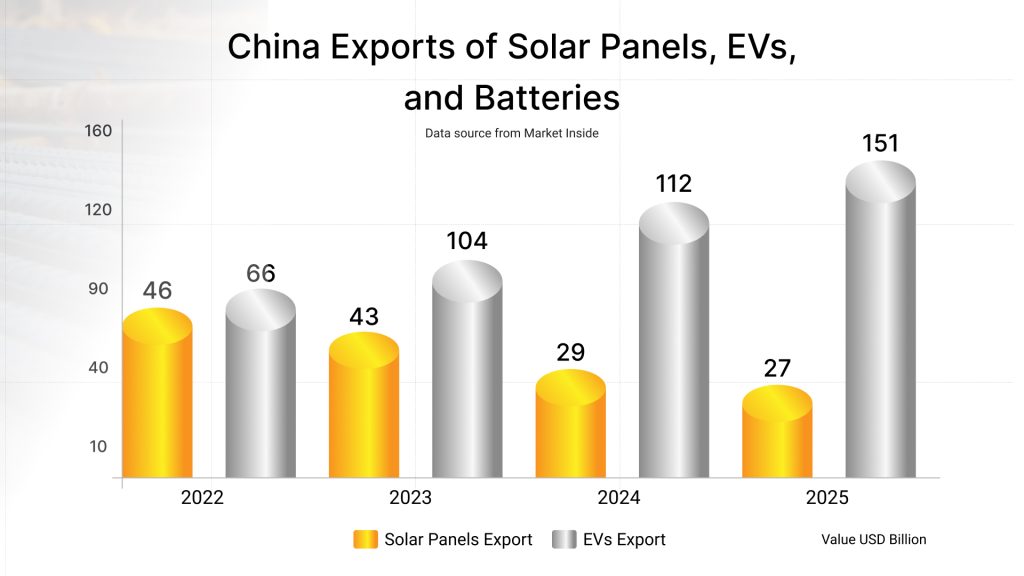
| Year | Solar Panels Export | EVs Export |
| 2022 | 46 | 66 |
| 2023 | 43 | 104 |
| 2024 | 29 | 112 |
| 2025 | 27 | 151 |
*****Value USD Billion
Green Trade Volume Trends
From 1990 to 2019, green exports between developing countries rose about 18-fold, reflecting growing integration of environmental products into global value chains. However, high-income countries still dominate green trade exports in absolute terms.
Global Trade Flows Are Being Reshaped
Green trade policies influence broader export dynamics:
- Countries with advanced eco-friendly technology strengthen export competitiveness.
- Export patterns increasingly prefer environmentally compliant products, while carbon-intensive goods face higher barriers.
- Global supply chains are adjusting, prioritizing low-carbon production to satisfy green regulatory requirements.
Concerns and Challenges
Impact on Developing Countries
Many developing countries lack the technology, financing, and institutional capacity to adapt quickly. Barriers such as carbon border tariffs and environmental standards risk reducing their export opportunities, especially for traditional industries.
Measurement & Reporting
A lack of universal standards for measuring emissions complicates compliance. Exporters may face higher costs if they cannot accurately report carbon footprints.
Risk of Trade Tensions
Critics argue that unilateral green trade measures could become a form of green protectionism, potentially leading to retaliatory trade policies and friction in multilateral trade systems.
Opportunities for Exporters
Innovation and Market Diversification
Exporters investing in low-carbon technologies and greener processes can:
- Access lucrative markets with high environmental standards.
- Reduce risk from future trade barriers.
- Stimulate domestic innovation ecosystems.
For example, firms adopting emissions trading or green innovation strategies have shown competitive resilience while fulfilling export standards.
Exporters of Green Goods
Exporters of renewable energy equipment, low-carbon machinery, and environmental services are seeing strong global demand, opening new trade corridors and partnerships.
Conclusion
Green trade policies, especially carbon border adjustments, environmental standards, and climate-linked reporting requirements are accelerating a fundamental shift in global trade. While these policies aim to reduce emissions and promote sustainable growth, they have real economic impacts on export competitiveness, particularly for carbon-intensive sectors.
Understanding these dynamics is easy with Market Inside and crucial for exporters, policymakers, and investors seeking to navigate a future where climate policy and international trade are deeply interconnected.