
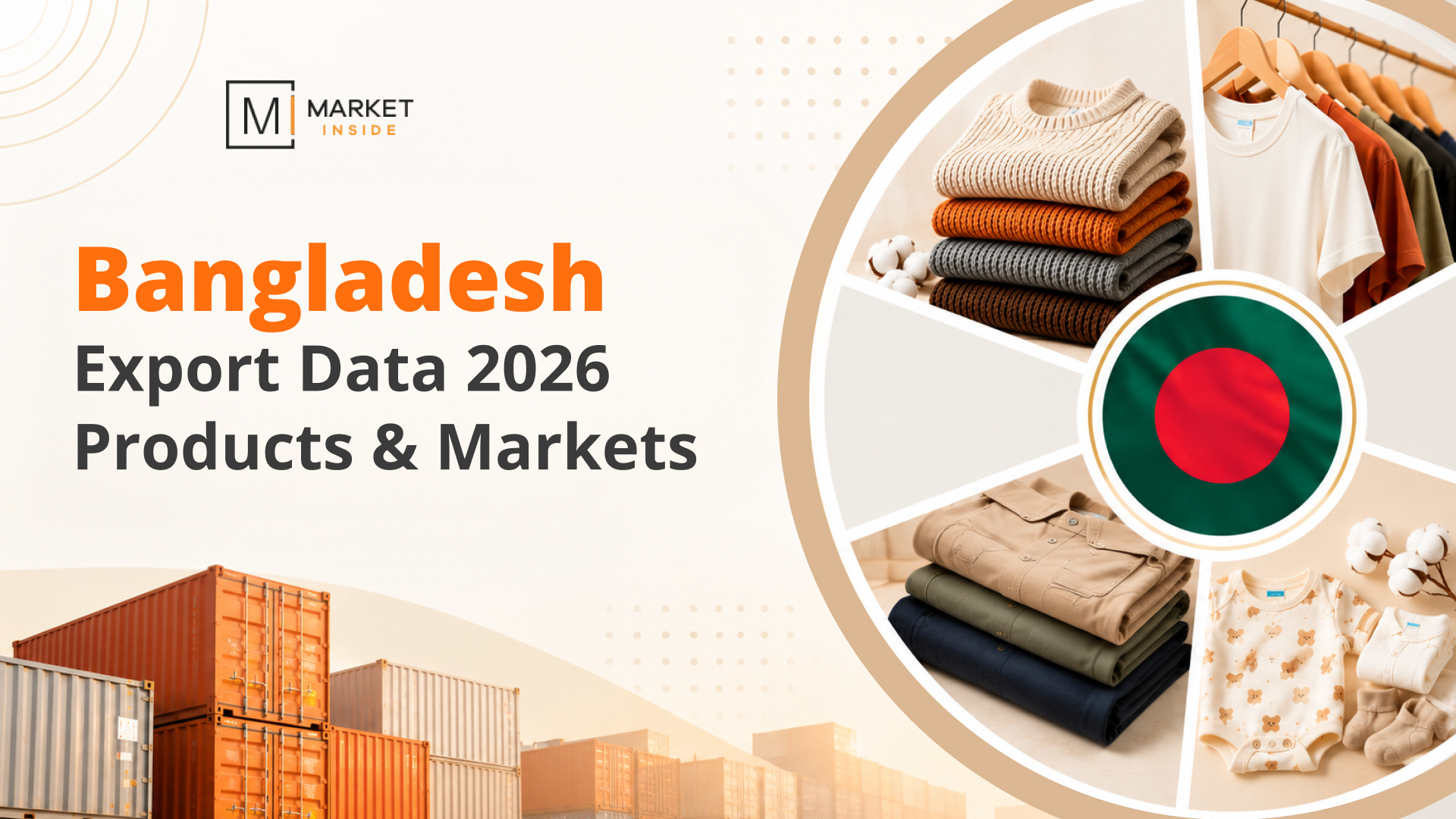
Bangladesh at a Glance: Location and Economy
Bangladesh is a South Asian country of some 170 million people, located on the Bay of Bengal, and bordered on the southeast by Myanmar. The capital, Dhaka, is one of the world’s most densely populated megacities, while Chattogram is a hub on the southeastern coast. The land is in the Ganges-Brahmaputra delta, one of the most fertile river basins on earth, which gives the country abundant water, a youthful workforce, and a naturally strong trading position between South and Southeast Asia.
That geography and labor base explain why exports are at the center of the economy. Bangladesh is the world’s second-largest garments exporter after China, and ready-made garments (RMG) account for the overwhelming majority of its merchandise exports. Understanding Bangladesh export data by HS code, month, port, and destination is the first step for importers, brands, and sourcing managers to build a reliable supply chain. This guide explains the latest numbers and what they mean for modern businesses.
Key Takeaways: Bangladesh Export Data at a Glance
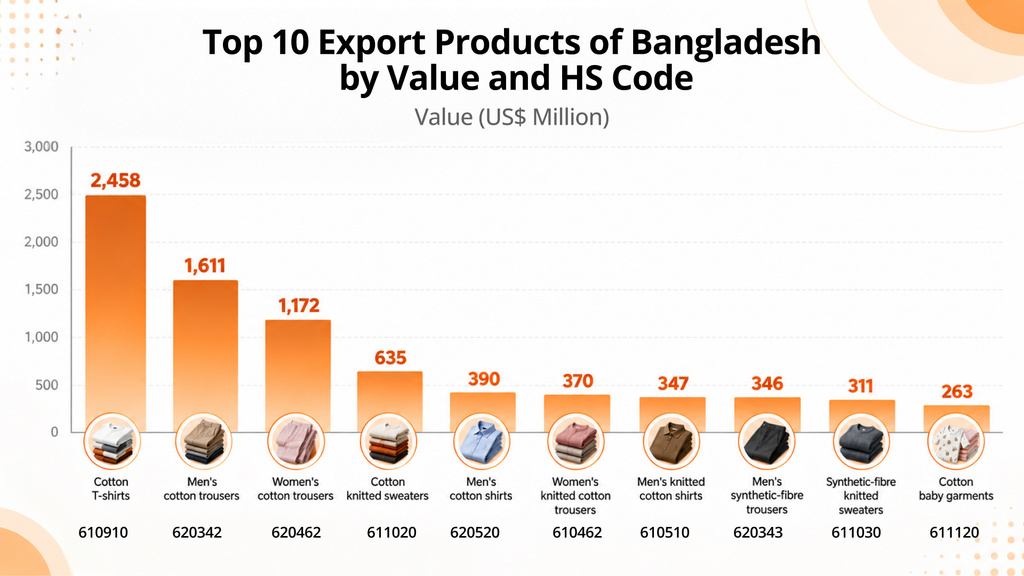
- Bangladesh top export products: Cotton T-shirts under HS 610910 are the leading product in the top 10, with export worth US$2,458 million around 31 of their combined value.
- Knitwear makes up 55.5% of the top 10 products by export value, while woven garments account for approximately 44.5%. Cotton products represent about 92% of the total.
- Bangladesh export markets: The United States is the largest market, importing US$8,962 million worth of goods in 2025, up 16.2% from 2023. Germany, the UK, Spain, and France are also key markets.
- Chattogram (Chittagong) handles around 95% of Bangladesh’s export value in 2025, making it an important gateway for business trading with Bangladesh.
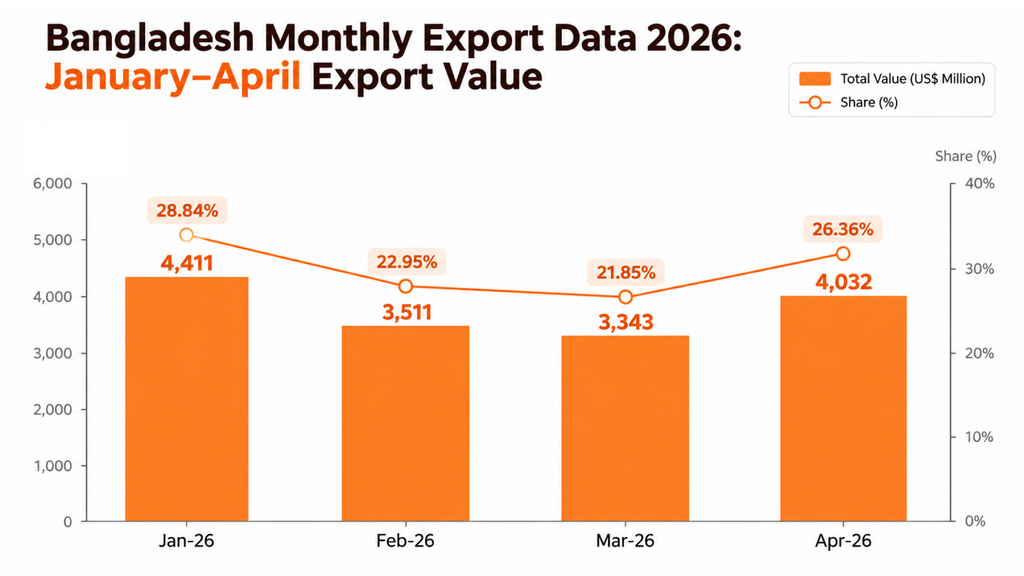
- Bangladesh exports reached US$15,297 million from January to April 2026. January recorded the highest value of US$4,411 million, while March saw the lowest at US$3,343 million before exports rebounded in April.
- Bangladesh sourcing opportunities: Man-made fibre clothing, higher-value knitwear, and textile materials offer potential opportunities for buyers. Non-traditional markets accounted for 17.13% of apparel exports in the latest quarter, highlighting opportunities to explore markets beyond established destinations.
Bangladesh’s top exports are dominated by the cotton garment industry, including T-shirts, sweaters, shirts, and baby clothing, as well as products made from synthetic fibers. The data below ranks the top 10 Bangladesh export products by value from January to April 2026, with HS codes to help importers compare product demand and identify sourcing opportunities.
Top 10 Export Products of Bangladesh by Value and HS Code (Jan to April 2026)
Bangladesh’s export data highlights that its export basket rests on cotton basics such as T-shirts, sweaters, shirts, and baby garments, plus synthetic-fibre trousers and sweaters. Importers can use each six-digit harmonised system (HS) code to identify top products and compare their export values.
| Rank | HS Code | Product Description | Total Value (US$ Million) |
|---|---|---|---|
| 1 | 610910 | Cotton T-shirts | 2,458 |
| 2 | 620342 | Men’s cotton trousers | 1,611 |
| 3 | 620462 | Women’s cotton trousers | 1,172 |
| 4 | 611020 | Cotton knitted sweaters | 635 |
| 5 | 620520 | Men’s cotton shirts | 390 |
| 6 | 610462 | Women’s knitted cotton trousers | 370 |
| 7 | 610510 | Men’s knitted cotton shirts | 347 |
| 8 | 620343 | Men’s synthetic-fibre trousers | 346 |
| 9 | 611030 | Synthetic-fibre knitted sweaters | 311 |
| 10 | 611120 | Cotton baby garments | 263 |
Bangladesh top export products –
- Cotton trousers are a major export category of Bangladesh’s export industry. Men’s and women’s cotton trousers under (HS 620342 and HS 620462) give a combined export value of US$2,783 million, accounting for around 35% of the top 10 products by value.
- Notably, cotton T-shirts lead Bangladesh garment exports. T-shirts under HS 610910 witnessed nearly four times as much as cotton sweaters (HS 611020), highlighting the importance of knitwear in Bangladesh’s exports.
- Sweaters contribute significantly to Bangladesh export data. Cotton and synthetic sweaters (HS611020) reached US$946 million, around 12% of the top 10 total. Cotton sweaters earned twice as much as synthetic-fiber sweaters.
- Synthetic-fibre trousers show room to explore new sourcing options. Exports of synthetic-fibre trousers (HS 620434) reached around 21% of the value recorded for cotton trousers, highlighting the difference between these product categories.
- Interestingly, Bangladesh exports of baby garments (HS 611120) offer a specialised sourcing category worth US$263 million in exports.
Bangladesh’s export data shows strong expertise in cotton basics but room to grow in man-made fibre clothing. For buyers, this creates an opportunity to diversify sourcing, explore new product categories, and track monthly exports to plan orders and negotiate better prices.
Bangladesh’s top exports show what buyers can source from Bangladesh, but with monthly export data, businesses can understand when shipments peak, when they slow down, and how buyers can use these changes to plan their next orders
Bangladesh Monthly Export Data 2026: January-April Export Value
According to Bangladesh export data by month, clothing export value from jan-april 2026 exhibits a seasonal pattern of demand. In January, demand was high, and it slowed from Feb to April. These monthly figures and the share of the four-month totals aid buyers in planning when to ship and when to make them. To understand the market perfectly, explore the latest Bangladesh shipment records and see which products and buyers are active.
| Month | Total Value (US$ Million) | Share (%) |
|---|---|---|
| Jan-26 | 4,411 | 28.84% |
| Feb-26 | 3,511 | 22.95% |
| Mar-26 | 3,343 | 21.85% |
| Apr-26 | 4,032 | 26.36% |
Key Insights: Bangladesh Monthly Export Data
- Bangladesh Monthly Exports: Bangladesh averaged US$3,824 million in monthly exports from January to April 2026.
- January exports were about 32% higher than in March, the weakest export month in the first four months.
- According to Bangladesh exports analytics, Bangladesh exports average (per day) US$142 million in January, US$125 million in February, US$108 million in March, and US$134 million in April.
- Notably, Ramadan and Eid-ul-Fitr fell between mid february and late March 2026, potentially affecting factory production and port activity during this period.
Bangladesh’s export data reveals more than seasonal ups and downs—it shows when buyers may find room to negotiate and when demand picks up. Planning orders around these shifts can help businesses secure capacity, manage costs, and avoid shipment delays.
Knowing when Bangladesh exports rise is only part of the picture. The next step is understanding which ports handle the cargo, helping buyers plan shipping routes and anticipate potential logistics delays.
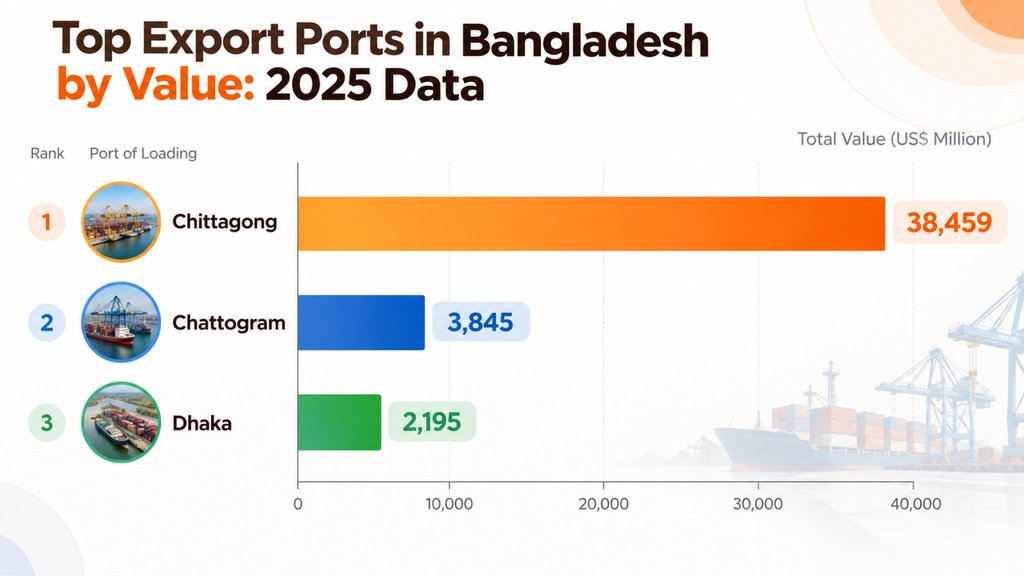
Top Export Ports in Bangladesh by Value: 2025 Data
Every T-shirt, trouser, and sweater leaves Bangladesh through a few gateways. Sea cargo moves through Chattogram, also spelled Chittagong, while Dhaka’s airport and inland depots serve urgent, high-value shipments, so port choice shapes lead time and freight cost.
| Rank | Port of Loading | Total Value (US$ Million) |
|---|---|---|
| 1 | Chittagong | 38,459 |
| 2 | Chattogram | 3,845 |
| 3 | Dhaka | 2,195 |
Key Insights: Bangladesh Export Ports
- Chattogram is the leading Bangladesh export port: Chattogram accounts for around 95% of the total value of the three listed ports, and is the main gateway for Bangladesh’s export trade.
- Urgent shipments supported by Dhaka: Dhaka is involved in air freight and inland logistics facilities for urgent and high-value goods,s with a port value of US$2,195 million, or about 5% of the port’s listed value.
- Port data matters: Trade data may show Chittagong and Chattogram as separate places. The names are merged to avoid multiple entries for the same business when looking for export data for Bangladesh by port.
- Risks of shipping due to port concentration: Over-dependence on Chattogram creates congestion; strikes or adverse weather disrupt shipments and thus delivery schedules across product categories.
- Alternative routes for flexibility: Alternative shipping routes through Mongla, Payra, and land ports such as Benapole may be available for selected products, allowing exporters and importers to consider routes other than the main gateway.
Chattogram’s importance for the country’s trade is reflected in Bangladesh’s export data. Tracking port congestion, vessel schedules, and terminal developments can help buyers avoid costly delays and keep their sourcing plans on schedule. Next, let’s see who buys Bangladesh’s exports
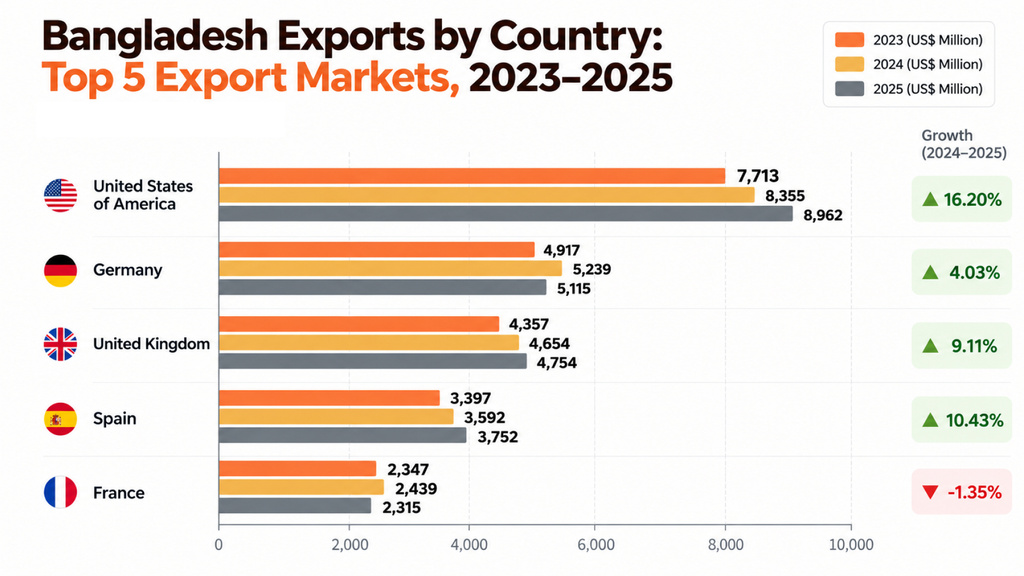
Once you understand what Bangladesh exports and how its goods move through key ports, the next question is where those products go. The table below highlights Bangladesh’s top five export destinations from 2023 to 2025, helping businesses spot key markets and potential growth opportunities.
Top 5 Export Destinations of Bangladesh Exports by Country 2023-2025
Five Western economies, mainly the United States, Germany, the United Kingdom, Spain, and France, buy Bangladesh’s trousers, T-shirts, and knitwear. Three-year export value shows where destinations are growing and where they are flattening.
| Rank | Destination Country | 2023 (US$ Million) | 2024 (US$ Million) | 2025 (US$ Million) | Growth (2023–25) |
|---|---|---|---|---|---|
| 1 | United States of America | 7,713 | 8,355 | 8,962 | 16.20% |
| 2 | Germany | 4,917 | 5,239 | 5,115 | 4.03% |
| 3 | United Kingdom | 4,357 | 4,654 | 4,754 | 9.11% |
| 4 | Spain | 3,397 | 3,592 | 3,752 | 10.43% |
| 5 | France | 2,347 | 2,439 | 2,315 | −1.35% |
Key Insights: Bangladesh Export Markets
- United States leading Bangladesh export markets: The US accounts for some 36% of the combined value of the top five destinations, with exports increasing by 7.3% in 2025.
- Slower growth for Germany and France: Exports to Germany fell about 2.4% and France about 5.1% in 2025 versus 2024. But the EU still accounted for 46.36% of Bangladesh’s apparel exports in July-September 2026.
- UK is still a key market: The UK ranked second in the last quarter with US 1.370 billion in exports, followed by Germany at US1.218 billion.
- Growing opportunities for exports to Spain: Exports to Spain grew by 10.43% in 2023, providing a market to watch for businesses wanting to tap into Bangladesh’s export growth.
- Market concentration is important. The top five export destinations for Bangladesh are valued at US$ 24,898 million. Monitoring these markets helps exporters and sourcing teams assess demand changes and reduce dependence on a small number of buyers.
Bangladesh’s export growth is encouraging, but depending on a few major markets is risky. Tracking demand across countries and looking at emerging markets can help exporters and buyers protect sales, diversify sourcing, and build more resilient trade relationships.
Business Opportunities for B2B Buyers and Investors
The data points to practical openings across the value chain.
- Apparel made from man-made fibers: With global activewear and athleisure continuing to grow, the clearest white space for sourcing and investment is MMF garments, recycled polyester, and blended fabrics,cs with synthetic items making up less than 9% of the top-10 list.
- Sweaters and knitwear with added value. Cotton and synthetic sweaters (HS 6110) are a plus US$900 million category. Buyers can demand higher-margin, design-intensive programs.
- Backward linkages: Many fabrics are still import-dependent for spinning, weaving, dyeing, and the supply of trims. Captive demand from garment factories is there for textile mills, effluent treatment, and accessories.
- Diversification of the market: The EU and UK grew slower than non-traditional markets. Bangladesh wants to cut its dependence on a few Western economies, and exporters and buyers in Japan, Australia, and other markets can negotiate favorable terms.
- Production that is sustainable and compliant: Bangladesh has many LEED-certified green garment factories, and EU due diligence and traceability rules favor suppliers who can prove compliance. Certified capacity is a premium to sell.
- Non-RMG – Diversification: Leather and footwear, jute goods, home textiles, pharmaceuticals, light engineering, and agro-processing are growing contributors that help reduce exposure to apparel cycles.
- Logistics and ICD services: Concentration at Chattogram creates demand for inland depots, warehousing, feeder services, and digital customs solutions.
FAQs About Bangladesh Export Data
What is Bangladesh’s top export product by value?
Cotton T-shirts (HS code 610910) are the leading product in the ranking, with exports valued at US$2,458 million from January to April 2026.
Which country is Bangladesh’s largest export market?
The United States is Bangladesh’s largest export market, with US$8,962 million in imports from Bangladesh in 2025.
What are Bangladesh’s top export products and HS codes?
Bangladesh’s leading export products include cotton T-shirts, cotton trousers, knitwear, woven garments, and sweaters. Their HS codes help buyers identify product categories and compare export values in Bangladesh export data.
Which port handles the most exports in Bangladesh?
Chattogram, also known as Chittagong, is Bangladesh’s leading export port. It handles the vast majority of the port value in the data analysed, making it important for shipment planning and sourcing decisions.
How fast are Bangladesh’s exports growing?
Bangladesh’s merchandise exports grew by 6.34% in July–September 2026. Tracking monthly Bangladesh export data helps businesses assess changing demand, plan orders, and monitor market trends.
Which countries are Bangladesh’s main export markets?
The United States, Germany, the United Kingdom, Spain, and France are among Bangladesh’s leading export destinations. Comparing Bangladesh export markets can help businesses identify established buyers and assess opportunities to diversify sales.
Is Bangladesh’s export industry limited to garments?
No. Ready-made garments dominate Bangladesh exports, but other sectors include leather products, jute goods, pharmaceuticals, home textiles, and light engineering. Exploring these categories can help buyers identify additional Bangladesh sourcing opportunities.
How can businesses use Bangladesh export data for sourcing?
Businesses can analyse export products, HS codes, destination markets, shipment trends, and port activity to identify potential suppliers, compare sourcing options, monitor demand, and make better-informed purchasing decisions.
Conclusion
The story the export numbers tell in Bangladesh is a consistent one. A cotton-led, knitwear-heavy apparel powerhouse that runs through one dominant port and is concentrated in a few Western markets is now recovering from a soft year with renewed growth. B2B buyers’ smartest moves are to lock in capacity early, examine man-made fibers and value-added lines, and spread across markets and suppliers. Best returns for investors are from textile backward linkages, logistics, and compliance-ready capacity.
See Trade Intelligence in Action
Get a personalized walkthrough of our trade intelligence platform and discover new buyers, markets, and opportunities.
Schedule a Demo →