

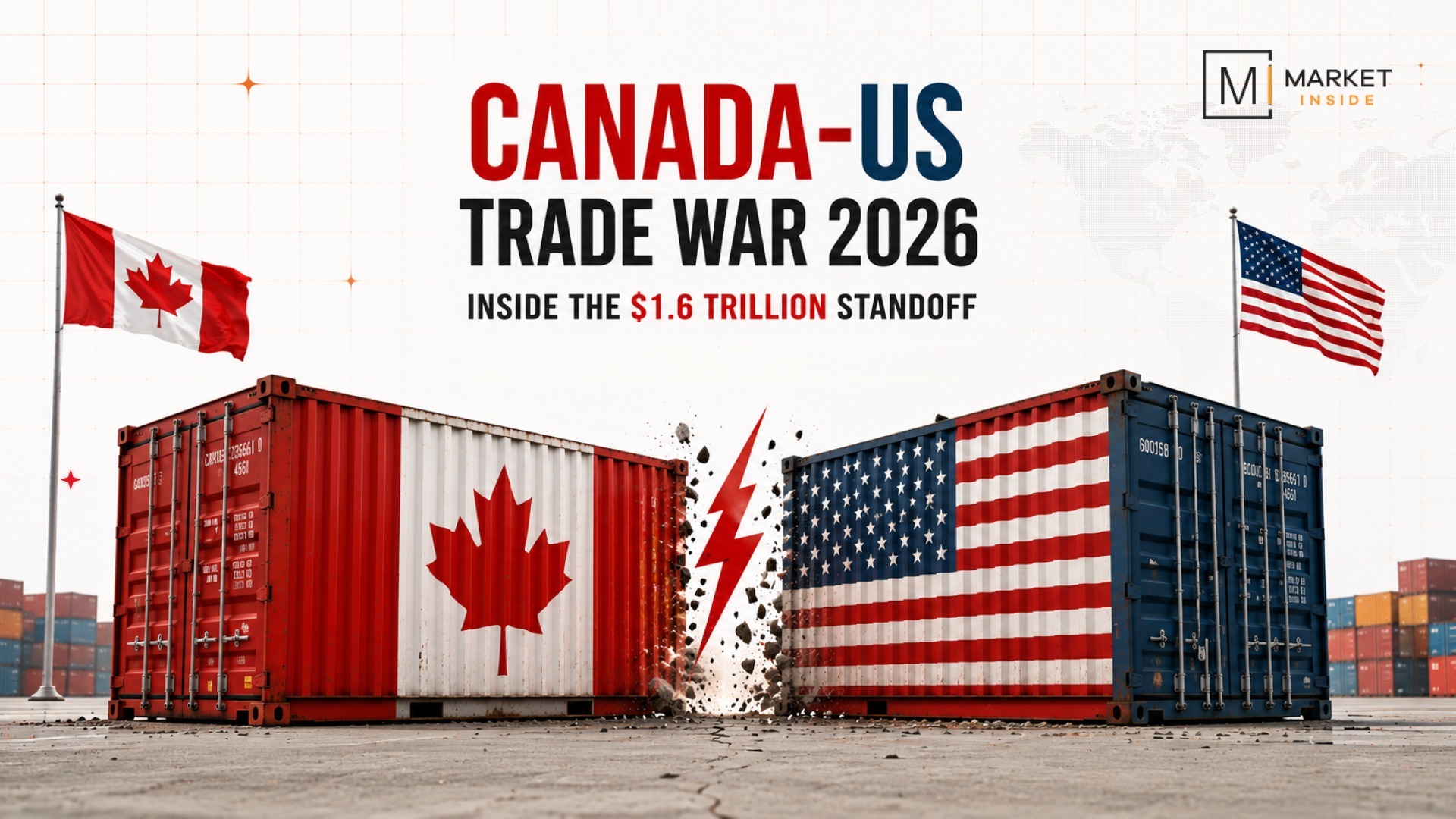
Key takeaways –
- Canada remains heavily dependent on the US for its imports: The top Canadian imports from the US continue to be energy, vehicles, parts, and industrial goods.
- Diversification is in the works: Canada’s global import growth indicates early movement to alternative sourcing markets.
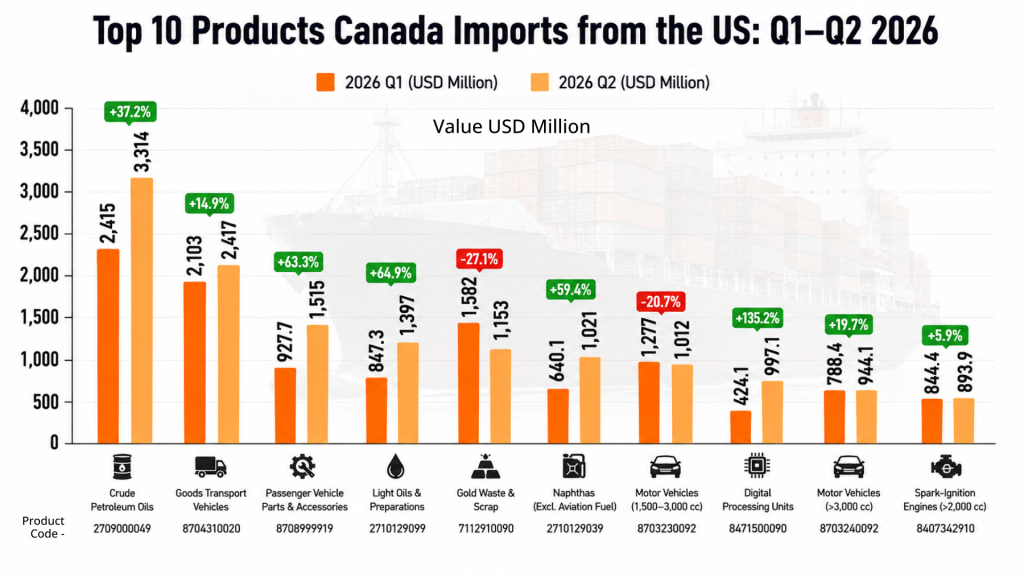
- Auto supply chains remain vulnerable: US vehicle parts, accessories up 63.3% in Q2
- The boom in digital imports: US digital processing units more than doubled to 135.2 percent.
- U.S. imports that declined included motor vehicles (-20.7 percent) and gold waste and scrap (-27.1 percent).
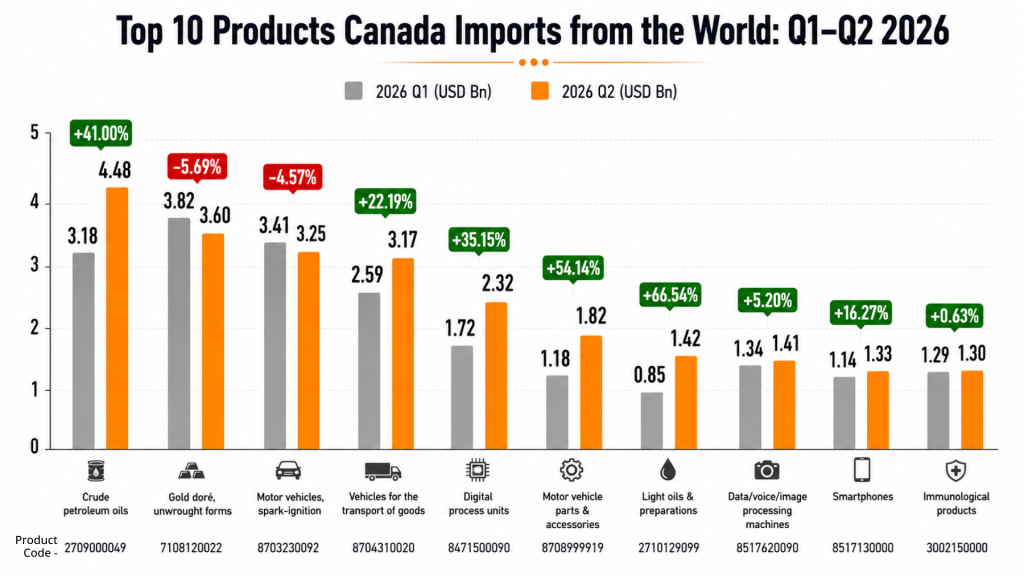
- Canada’s imports of light oils from the world soared 66.54%, as global sourcing gains momentum.
- Trade data shows early changes: HS-code-level data can identify sourcing changes before tariffs have fully reshaped supply chains.
A Trade War That Started With a Handshake and Ended With “Fall in Line”
Imagine spending sixty years building the world’s most tightly woven supply chain — one in which a single car part can cross a border four or five times before it is even screwed into a vehicle — and then watching it threaten to unravel in a matter of weeks.
That’s roughly where the Canada-US trade war stood in 2026 by late August.
Trade talks between Prime Minister Mark Carney and the Trump administration didn’t just stall; they collapsed. Carney walked out of the table on a Friday, just hours before a US deadline that would have imposed a 50% levy on almost $20 billion worth of Canadian goods. Trump’s response was anything but conciliatory. He said Canadian leaders should get on board or face consequences worse than the tariffs already in place, and confirmed a 50% tariff on Canadian vehicles, auto parts, and steel would take effect from January 1 — double the current 25% rate.
Canada, for its part, is not backing down quietly. Ottawa is working on new retaliatory tariffs, but officials say the response may no longer be a simple dollar-for-dollar response. Instead, there will be more surgical measures to protect specific industries and workers.
So it is worth pondering the question: if two economies that are so deeply intertwined start to drift apart, who actually blinks first? More importantly, where does a country like Canada turn when its biggest customer starts acting like a landlord instead of a partner?
The answer, it turns out, is hiding in the Canada-US trade data.
Canada-US Trade War 2026: Why It’s About More Than Tariffs
At face value, this looks like a tariff dispute. Under it all is a fight for industrial sovereignty.
Washington has been accused by Carney of insisting on terms that would have gradually drained Canada’s auto, steel and aluminum sectors, which support tens of thousands of jobs on both sides of the border. He rebuffed any negotiating posture that would treat Canada as a lesser partner, calling the present US-Canada auto relationship one of the most successful manufacturing partnerships in history, one that Washington now appears determined to tear apart rather than renew.
Ontario Premier Doug Ford, whose province is home to most of Canada’s vehicle manufacturing, has been characteristically blunt in his public response to Trump and has floated the idea of using Ontario’s exports of electricity, oil, gas, and critical minerals to the US as leverage. Ontario already sells power to about 1.5 million American homes and businesses and has previously levied surcharges on electricity sold to Michigan, Minnesota, and New York in previous friction.
US Trade Representative Jamieson Greer has challenged Ottawa’s version of events, arguing that Canada’s auto industry itself exists largely because of a US market-access arrangement that dates to the 1960s — and that Canada introduced late demands of its own.
Meanwhile, the larger USMCA agreement that supports some $1.6 trillion in North American trade is now up in the air. Canada and Mexico want to extend it by 16 years. The US has said it will not renew the pact as it is. Oxford Economics has warned that a collapse of the USMCA could send Canada into recession and knock it onto a permanently lower growth path.
That’s the backdrop. Now let’s look at what’s actually moving through the pipes.
The Numbers: What Canada Is Actually Buying (and From Whom)
Trade disputes are usually couched in political terms — insults, deadlines, threats. But the real thing is the numbers. Canada Import data reveals the specific sectors that are exposed, which are accelerating through the noise, and which are already pulling away from US dependence
Top 10 Products Canada Imports from the US: Q1-Q2 2026
| Product Code | Product Canada Import from US | 2026 Q1 | 2026 Q2 | Growth Q1–Q2 |
|---|---|---|---|---|
| 2709000049 | Crude Petroleum Oils | 2,415 | 3,314 | +37.2% |
| 8704310020 | Goods Transport Vehicles | 2,103 | 2,417 | +14.9% |
| 8708999919 | Passenger Vehicle Parts & Accessories | 927.7 | 1,515 | +63.3% |
| 2710129099 | Light Oils & Preparations | 847.3 | 1,397 | +64.9% |
| 7112910090 | Gold Waste & Scrap | 1,582 | 1,153 | -27.1% |
| 2710129039 | Naphthas (Excl. Aviation Fuel) | 640.1 | 1,021 | +59.4% |
| 8703230092 | Motor Vehicles (1,500–3,000 cc) | 1,277 | 1,012 | -20.7% |
| 8471500090 | Digital Processing Units | 424.1 | 997.1 | +135.2% |
| 8703240092 | Motor Vehicles (>3,000 cc) | 788.4 | 944.1 | +19.7% |
| 8407342910 | Spark-Ignition Engines (>2,000 cc) | 844.4 | 893.9 | +5.9% |
Notice a pattern? Canadian imports of vehicle parts, engines, and refined oil products from the US grew in some categories dramatically even as the political relationship soured in Q1 and Q2 of 2026. Digital processing units more than doubled. That’s the paradox of highly integrated supply chains: a business can not politically unwind in a quarter what took 60 years to build
But look at the categories that shrank a little more closely. Motor vehicles over 1500cc down over 20%. Gold waste and scrap fell 27%. Those declines are early tremors — the first signs of buyers quietly testing other suppliers before the tariff wall goes up on January 1.
Top 10 Products Canada Imports from The World: Q1-Q2 2026
Light oils & preparations, 66.5% up, fastest-growing global import category. Crude petroleum oils were the largest single import for Q2 at $4.48 billion. Biggest decliner: Gold doré, -5.7%
What matters is this: if you put the two tables side-by-side, you see that Canada’s global sourcing of vehicle parts and light oils is growing faster than its US-specific imports of the same items. That’s not a coincidence – it’s a diversification signal, and it’s happening in real time, months before a single new tariff goes into effect.
| HS Code | Product | 2026 Q1 (USD Bn) | 2026 Q2 (USD Bn) | Growth Q1–Q2 |
|---|---|---|---|---|
| 2709000049 | Crude petroleum oils | 3.18 | 4.48 | +41.00% |
| 7108120022 | Gold doré, unwrought forms | 3.82 | 3.60 | -5.69% |
| 8703230092 | Motor vehicles, spark-ignition | 3.41 | 3.25 | -4.57% |
| 8704310020 | Vehicles for the transport of goods | 2.59 | 3.17 | +22.19% |
| 8471500090 | Digital process units | 1.72 | 2.32 | +35.15% |
| 8708999919 | Motor vehicle parts & accessories | 1.18 | 1.82 | +54.14% |
| 2710129099 | Light oils & preparations | 0.85 | 1.42 | +66.54% |
| 8517620090 | Data/voice/image processing machines | 1.34 | 1.41 | +5.20% |
| 8517130000 | Smartphones | 1.14 | 1.33 | +16.27% |
| 3002150000 | Immunological products | 1.29 | 1.30 | +0.63% |
Why Trade Data Is the Real Weapon in This Fight
And here is where it gets really interesting for anyone watching global commerce, not just economists.
Governments and companies don’t wait for tariffs to arrive before they act. — HS code by HS code, country by country — to spot which suppliers are gaining share and which are losing it, often weeks or months before headlines catch up.
For Canada, that means the current dispute is more than a defensive scramble. Carney’s government has already committed some $8 billion to build six new icebreakers domestically in Quebec, as part of a broader effort to reduce reliance on the US and open new Arctic and Atlantic shipping routes. Add in rising imports of light oils, digital processing units, and vehicle components from non-US sources, and you start to get a picture. Canada isn’t just retaliating. It is actively re-wiring its supply chain in real time.
The lesson is even sharper for businesses. Granular trade data, broken down by HS code, quarter, and origin country, helps importers and exporters identify alternative buyers and suppliers before a crisis forces them to act.
A Canadian auto parts buyer who sees US shipments fall 20% in a quarter doesn’t need to read a news article to know it’s time to diversify – the shipment manifests already told them.
That’s the uncomfortable truth behind every tariff headline: by the time politicians say it’s a trade war, the smartest players have already begun rerouting it.
Tariffs change overnight, but supply chains move quietly. The companies watching trade data today will be the ones prepared for tomorrow’s sourcing reality.
Canada 50% Auto Tariff January 2026: What Happens Next
Trump has slapped new 50% tariffs on Canadian autos, parts and steel, to go into effect Jan. 1. Ottawa, meanwhile, remains open to resuming negotiations should Washington return with a better offer, Carney has said. For now, the two governments are on a collision course, and not just in terms of political rhetoric, but in terms of billions of dollars crossing the 49th parallel every single quarter.
Whether this results in a renegotiated USMCA, a protracted tariff standoff, or a true reshuffling of North American supply chains, one thing is already clear in the data: Canada isn’t waiting to find out. It looks somewhere else already.
And that’s how the biggest trade shifts usually start, not with an announcement, but with a shipment manifest quietly going somewhere new.
Conclusion
The Canada-US trade war is already affecting sourcing decisions. Canada remains heavily reliant on U.S. supply chains while diversification gains momentum, according to data from Q1-Q2 2026. The real story isn’t just the tariffs. It’s where shipments go next. Businesses monitoring trade data benefit from early detection of risks, alternatives, and the ability to act before competitors.
FAQ: Canada-US Trade War 2026
Why did the Canada-Trump trade talks collapse?
Carney walked away from negotiations after Washington introduced last-minute demands Ottawa considered unacceptable, including limits on which countries Canada could sign trade deals with. The US disputes this account, saying Canada introduced its own late changes.
When does the Canadian 50% auto tariff in January 2026 take effect?
January 1, 2026, on Canadian vehicles, auto parts, and steel — up from the current 25% rate.
What is the impact of Canada’s steel and aluminum tariffs expected to be?
Analysts warn a full USMCA breakdown could push Canada into recession, given how deeply the auto, steel, and aluminum sectors are integrated with US manufacturing.
Is Canada diversifying trade away from the US?
Early signs suggest yes — global import growth in vehicle parts and light oils is outpacing US-specific import growth in the same categories, and Ottawa has announced major domestic infrastructure investment (six new icebreakers) tied to reducing US dependence.
See Trade Intelligence in Action
Get a personalized walkthrough of our trade intelligence platform and discover new buyers, markets, and opportunities.
Schedule a Demo →