


Key Takeaways
- The United States is the top car importing country with $183.83Bn in 2025, despite a recent pullback from its 2024 peak.
- Top 5 of top car importing countries are the US, Germany, the UK, France, and Belgium.
- Since 2023, China has fallen almost halfway down the list of car-importing countries as its own EV manufacturing has boomed.
- Spain and the UK are the strongest annual growth markets among car-importing nations, while Brazil leads quarterly growth by a wide margin.
- The best and most actionable picture of global automotive demand comes from tracking annual and quarterly data from the top car-importing countries.
What Are the Top Car Importing Countries?
The top car importing countries are the countries that import the most vehicle dollars from foreign manufacturers each year. The following list is the top car importing countries, measured in US dollars (US$Bn) of import trade value under HS code 8703, the harmonized tariff classification for passenger vehicles.
These major car importing countries are generally large, high-income consumer markets with strong purchasing power but limited domestic vehicle production capacity relative to demand. Tracking car import statistics can help businesses understand where global vehicle demand is strongest — and where competitive opportunities exist for exporters, dealers, freight companies, and logistics providers monitoring car import data by country.
This is not to be confused with car exporting countries; a country can be high on both lists at the same time (Germany is the clearest example, covered in the comparison section below).
Why Car Import Rankings Matter in 2026
Knowing the top countries for car imports isn’t just academic — it directly informs:
- Automakers and dealers target the largest car-importing countries for market entry decisions
- Trade policy analysis for B2B buyers and government affairs teams
- Logistics planning and supply chain for freight and shipping companies that ship volume to top car importing countries
- Targeted marketing for automotive suppliers and aftermarket brands in high-import markets
Tracking car import statistics in 2026 is even more important because global car import trends are changing rapidly — some markets are importing far less as domestic and regional EV production ramps up, while others are importing significantly more as demand outstrips local supply.
Car Importing Countries vs Car Exporting Countries: What’s the Difference?
The position of a country among the leading car importers is not a factor in its position among the leading car exporters – the two lists measure completely different trade flows. The import rankings indicate how much a country buys from other countries, and the export rankings indicate how much it sells to other countries. If you’re looking for the best example of a country that ranks high on the list of top car importing countries and also on the list of top car exporting countries, look no farther than Germany. It’s a manufacturing juggernaut and a premium consumption market at the same time.
Top 10 Countries Importing Cars (2023-2025)
The table below shows the top car-importing countries by total import value in US$ billions, comparing 2023, 2024, and 2025.
Key Insights from Top Car Importing Countries Data
- The US is by far the biggest car-importing country, importing more than twice as many cars as the second-biggest car-importing country, Germany. There is a big drop of 12.6% in 2025 from the high in 2024.
- China has fallen sharply down the list of the largest car importing countries, with imports valued at $45.94Bn now down to $23.09Bn, a clear indication of China’s growing domestic (and export-oriented) EV manufacturing base reducing its reliance on imported vehicles.
- The UK and Spain are the fastest-growing markets of the major car importing countries, with the highest gains of +9.2% and +20.8%, respectively.
- France, Belgium, and the UAE are all trending down, showing softening demand or increased regional/domestic supply from these car-importing countries.
- Germany remains a top-2 car importing country despite also being the world’s #1 car exporter — reflecting its dual role as both a manufacturing hub and a premium consumer market.
The United States is the top car-importing country, importing $183.83 billion worth of vehicles in 2025 — almost 3 times more than the second-largest car-importing country, Germany, with $77.88 billion. The United Kingdom, France, and Belgium complete the top five car importers and together make up the bulk of global vehicle demand.
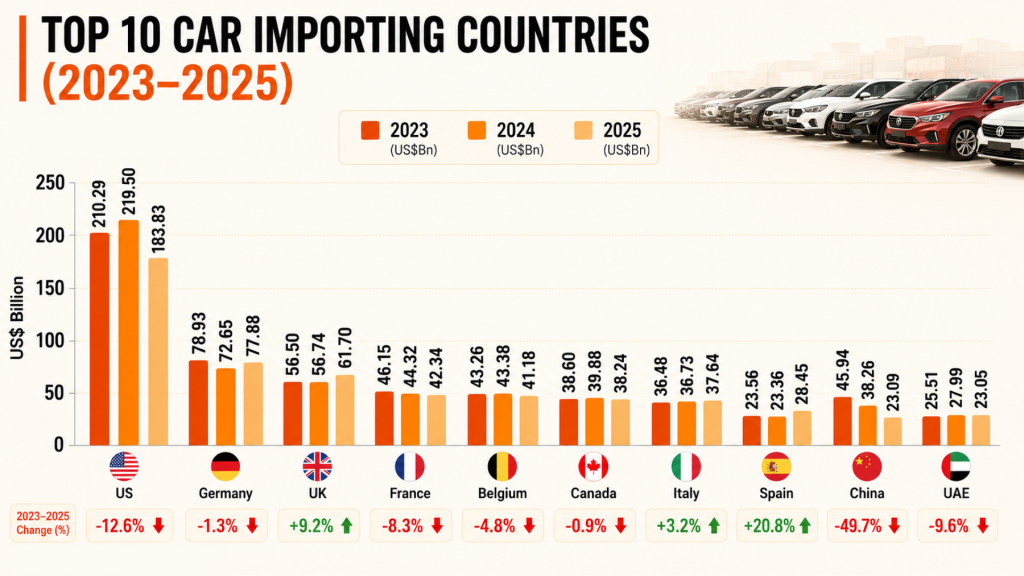
Top 10 Countries Importing Cars (2023-2025)
| Rank | Country | 2023 (US$Bn) |
2024 (US$Bn) |
2025 (US$Bn) |
2023–2025 Change |
|---|---|---|---|---|---|
| 1 | US | 210.29 | 219.50 | 183.83 | -12.6% |
| 2 | Germany | 78.93 | 72.65 | 77.88 | -1.3% |
| 3 | UK | 56.50 | 56.74 | 61.70 | +9.2% |
| 4 | France | 46.15 | 44.32 | 42.34 | -8.3% |
| 5 | Belgium | 43.26 | 43.38 | 41.18 | -4.8% |
| 6 | Canada | 38.60 | 39.88 | 38.24 | -0.9% |
| 7 | Italy | 36.48 | 36.73 | 37.64 | +3.2% |
| 8 | Spain | 23.56 | 23.36 | 28.45 | +20.8% |
| 9 | China | 45.94 | 38.26 | 23.09 | -49.7% |
| 10 | UAE | 25.51 | 27.99 | 23.05 | -9.6% |
Top Car Importers by Quarterly Trend (Q4 2025–Q2 2026)
The quarterly data points to short-term momentum for smaller but fast-moving car-importing countries. These are the top 10 by quarterly import value.
Key Insights from Quarterly Import Data
- Brazil’s surge more than doubled its import value in a single quarter – the biggest story in the quarterly data on car importing countries, and a strong signal of rebounding consumer or fleet demand.
- South Korea and New Zealand posted quarterly growth of more than 30%, outstripping most of the big car importing nations around the world.
- Argentina and Hong Kong are the only markets to post a quarterly decline, which is something to watch for potential currency or policy-driven demand softness.
- China’s imports are very small compared to its exports, which is consistent with the trend of China moving toward import substitution year after year.
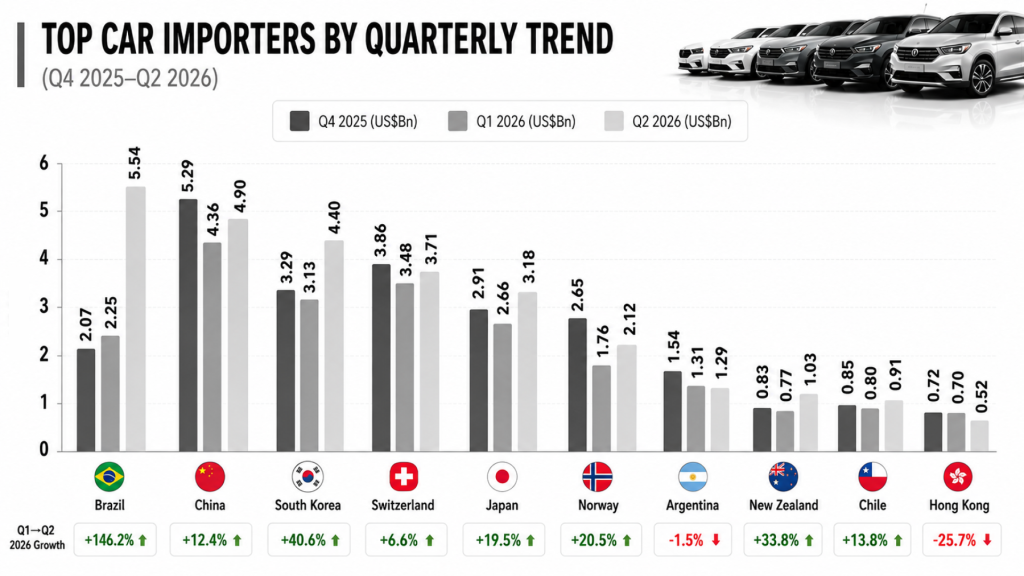
Top Car Importers by Quarterly Trend (Q4 2025–Q2 2026)
| Rank | Country | Q4 2025 (US$Bn) |
Q1 2026 (US$Bn) |
Q2 2026 (US$Bn) |
Q1→Q2 2026 Growth |
|---|---|---|---|---|---|
| 1 | Brazil | 2.07 | 2.25 | 5.54 | +146.2% |
| 2 | China | 5.29 | 4.36 | 4.90 | +12.4% |
| 3 | South Korea | 3.29 | 3.13 | 4.40 | +40.6% |
| 4 | Switzerland | 3.86 | 3.48 | 3.71 | +6.6% |
| 5 | Japan | 2.91 | 2.66 | 3.18 | +19.5% |
| 6 | Norway | 2.65 | 1.76 | 2.12 | +20.5% |
| 7 | Argentina | 1.54 | 1.31 | 1.29 | -1.5% |
| 8 | New Zealand | 0.83 | 0.77 | 1.03 | +33.8% |
| 9 | Chile | 0.85 | 0.80 | 0.91 | +13.8% |
| 10 | Hong Kong | 0.72 | 0.70 | 0.52 | -25.7% |
Top Car Importing Countries by Region
Grouping the top car importing countries by region adds useful context for B2B market planning:
- North America. The US and Canada are the key players here, with the US alone accounting for around a third of the value passing through the top 10 car-importing countries list, although 2025 was a pullback from its 2024 high.
- Europe: Germany, the UK, France, Belgium, Italy, and Spain are the 6 highest car-importing countries. Europe is by far the most import-dense region on this list, a testament to strong consumer demand and its importance as a hub for intra-regional trade.
- Asia Pacific: China is the largest car-importing country in terms of scale but is sharply falling as a car-importing country. Japan and South Korea are emerging as fast-growing car-importing countries on a quarterly basis.
- Middle East: The UAE remains a top-10 car importing country and continues to function partly as a re-export hub for the wider Gulf region.
What are the benefits of monitoring car import data?
The comprehensive car import data provides real strategic value for B2B buyers, marketers, and trade professionals tracking top car importing countries: for instance –
- Pre-competition. High demand car import markets
- Regional performance versus global car import trends
- Back up pricing and logistics decisions with real car import data
- Anticipate policy changes. Watch top car importing countries for import volume changes
- Automotive suppliers, dealers to lift sales forecast for world’s biggest car importers
These benefits translate into practical use cases for automakers, logistics firms, B2B suppliers, and market researchers, helping them spot demand shifts, prioritize markets, optimize decisions, and stay ahead of competitors. Here’s how businesses can apply car import data to make smarter market and growth decisions:
- An automaker uses import ranking data to prioritize the UK and Spain as expansion markets given their consistent growth.
- A freight and logistics company adjusts shipping capacity toward Brazil after spotting its quarterly import surge.
- A B2B parts supplier deprioritizes China as an import-dependent target market, recognizing its shift toward domestic production.
- A market research firm builds a quarterly dashboard tracking the top vehicle-importing nations for automotive clients.
Comparison: Top Importers vs. Top Exporters
Understanding top car importing countries alongside top exporters reveals the full global trade picture.
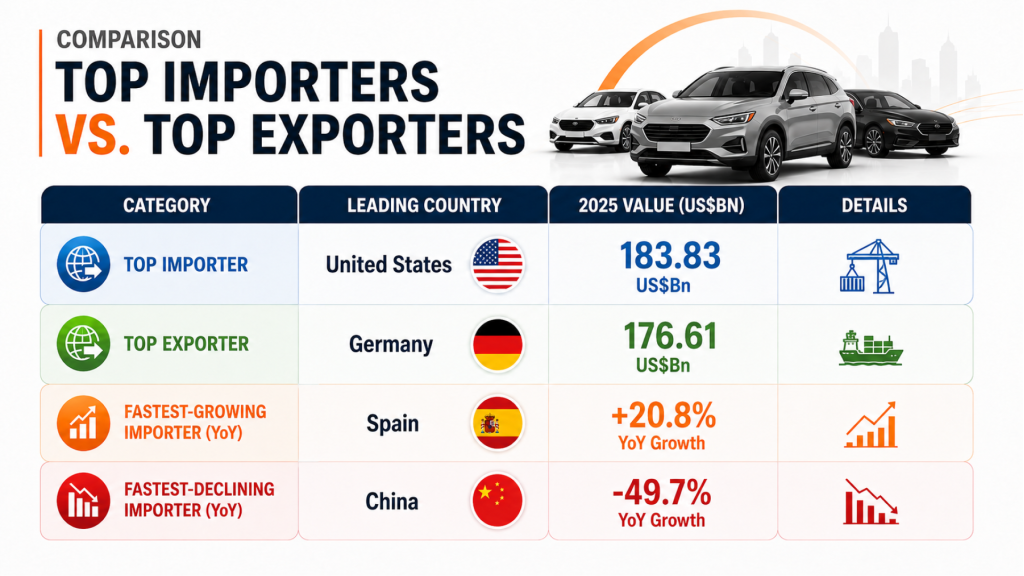
The U.S. is the world’s largest car importer but only a mid-tier exporter, while Germany leads global exports while also ranking as a top-2 importer — highlighting very different trade roles even among top economies.
Future trends in international car imports
- The expansion of local EV manufacturing in markets like China will likely further lower the dependence on imports in key car-importing countries.
- European markets (UK, Spain, Italy) are resilient and slightly up, likely to continue through the end of 2026
- The volatility of emerging markets (Brazil, Argentina) means that the demand for imports in these car importing regions will be unpredictable from quarter to quarter
- [Insert latest data] will be increasingly important to track separately from total vehicle import trends for EV-specific import trends.
- Through 2026 and beyond, trade policy changes, such as tariffs, EV incentives, and regional trade agreements, will remain the biggest wild card for rankings of top car-importing countries.
FAQs
Which country imports the most cars?
According to the car import data, the United States is the top car importing country in the world with $183.83 billion in vehicle imports in 2025 — nearly triple the value of Germany, the second-largest car importer.
What are the top 5 car-importing countries in 2025?
As per the car import data analysis, the top 5 car importers are the United States, Germany, the United Kingdom, France, and Belgium, based on 2025 car import value in US$ billions.
Why did China’s car imports drop so sharply?
China’s car imports fell nearly 50% from 2023 to 2025, primarily due to rapid growth in domestic EV manufacturing, reducing the country’s reliance on imported vehicles.
Which car-importing country is growing the fastest?
Among the top-10 annual car importers, Spain grew fastest, up 20.8% from 2023 to 2025. On a quarterly basis, Brazil posted the strongest growth, up over 146% in a single quarter.
How is car import data measured?
Car import rankings are based on the total declared US dollar value of vehicles imported into a country, as reported by customs authorities and compiled by trade organizations like the WTO and UN Comtrade.
Is Germany a car importer or exporter?
Both. Germany is the world’s top car exporter by value and simultaneously ranks as the second-largest car importer, reflecting its dual role as a manufacturing hub and premium consumer market.
How often is car import data updated?
Most trade authorities publish quarterly and annual car import data, making it possible to track both long-term trends and short-term shifts in the top car-importing countries.
Conclusion
The list of top car importing countries in 2026 tells a clear story: established giants like the U.S. and Germany still lead by scale, but the fastest-moving trends are happening elsewhere — in Spain’s steady climb, Brazil’s explosive quarterly growth, and China’s rapid pivot away from imports altogether.
For B2B buyers, marketers, and trade professionals, staying current on global car import trends isn’t optional — it’s a competitive necessity.
See Trade Intelligence in Action
Get a personalized walkthrough of our trade intelligence platform and discover new buyers, markets, and opportunities.
Schedule a Demo →