
China’s technology export mix is shifting fast in 2026. China’s Semiconductor exports boosted by AI memory chip boom.
According to China’s export trade data, Solar panel exports slowed after years of oversupply. Lithium-ion battery shipments rise before the new domestic consumption tax. Below, we dive into what China’s trade data reveals for three of its most watched tech export categories — batteries, solar cells, and semiconductors — using country-by-country and HS-code-level figures for Q1 and Q2 2026.
Quick answer: China’s semiconductor exports (HS 8542) grew the fastest of the three categories, up 44.6% in value from Q1 to Q2 2026, driven by a 67.3% jump in memory chip exports. China’s exports of lithium-ion batteries (HS 85076000) rose more moderately at 3.1%, while China’s exports of solar panels (HS 854143) actually fell 6.4% year-on-year as China digests domestic overcapacity.
Also Read this –
Beyond China Plus One: The New Global Sourcing Playbook for 2026
China’s Electric Vehicle Industry Shifts Gears: From Subsidies to Global Expansion
How China’s Battery, Solar, and Semiconductor Exports Compare
Before the China tech exports and product-level breakdowns, it helps to see all three tech export categories side by side. The snapshot below shows how China’s batteries, solar-linked products, and semiconductors are trending in 2026 — three distinct growth stories under one “China tech exports” umbrella.
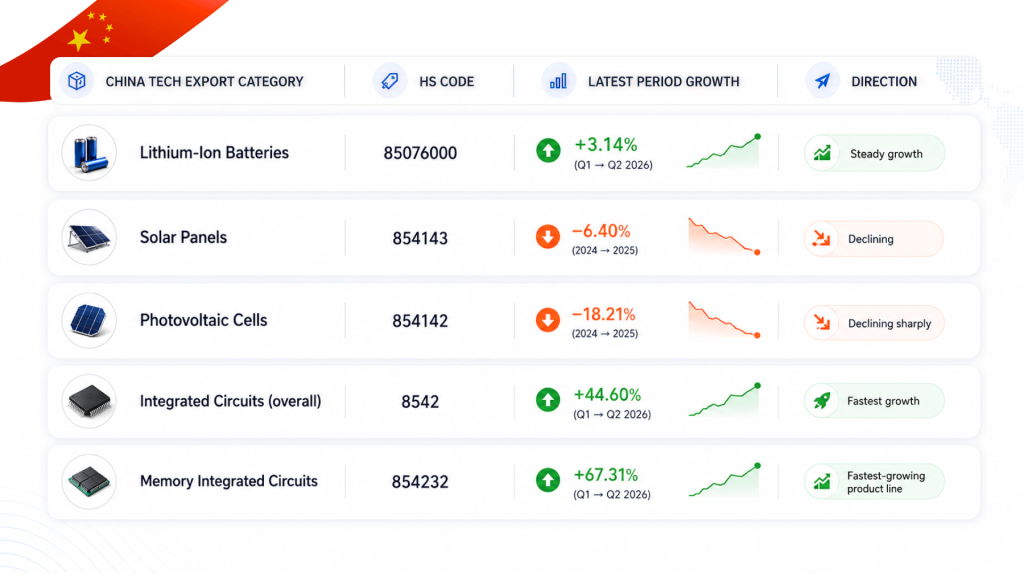
The China tech export comparison table is the clearest single answer to “which China tech export is growing fastest in 2026” — and it sets up why each category needs its own explanation rather than one blanket trend line.
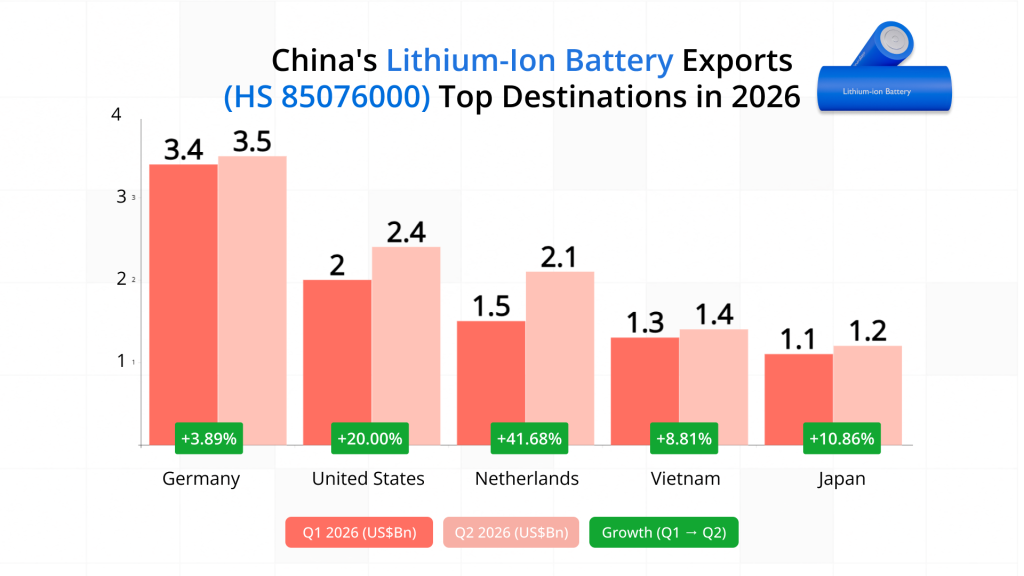
China’s Lithium-Ion Battery Exports (HS 85076000): Top Destinations in 2026
China’s lithium-ion battery exports grew a steady 3.14% overall between Q1 and Q2 2026, but the country-level picture is uneven. The Netherlands was the biggest importer of China’s lithium-Ion battery than any major destination, up 41.68%, followed by the US at 20%. Germany – still the single biggest buyer – grew a more modest 3.89%.
- Germany continues to lead in value in both quarters with $3.4 & $3.5 billion, respectively, highlighting its position as the centre of EV and energy storage production in Europe.
- The Netherlands is the standout gainer, growing over 41% quarter-on-quarter, likely tied to its position as a re-export and logistics gateway into the EU.
- The US surged 20% – a sharp acceleration in the face of ongoing trade friction between Washington and Beijing over the battery sector.
- The top five destinations made up 44% of world exports, up from about 40%, showing that demand for batteries is becoming even more concentrated among a small number of buyers.
China’s Lithium-Ion Battery Exports (HS 85076000): Top Destinations in 2026
| Destination Country | Q1 2026 (US$) | Q2 2026 (US$) | Growth (Q1 → Q2) |
|---|---|---|---|
| World | $23.9 | $24.7 | +3.14% |
| Germany | $3.4 | $3.5 | +3.89% |
| United States | $2.0 | $2.4 | +20.00% |
| Netherlands | $1.5 | $2.1 | +41.68% |
| Vietnam | $1.3 | $1.4 | +8.81% |
| Japan | $1.1 | $1.2 | +10.86% |
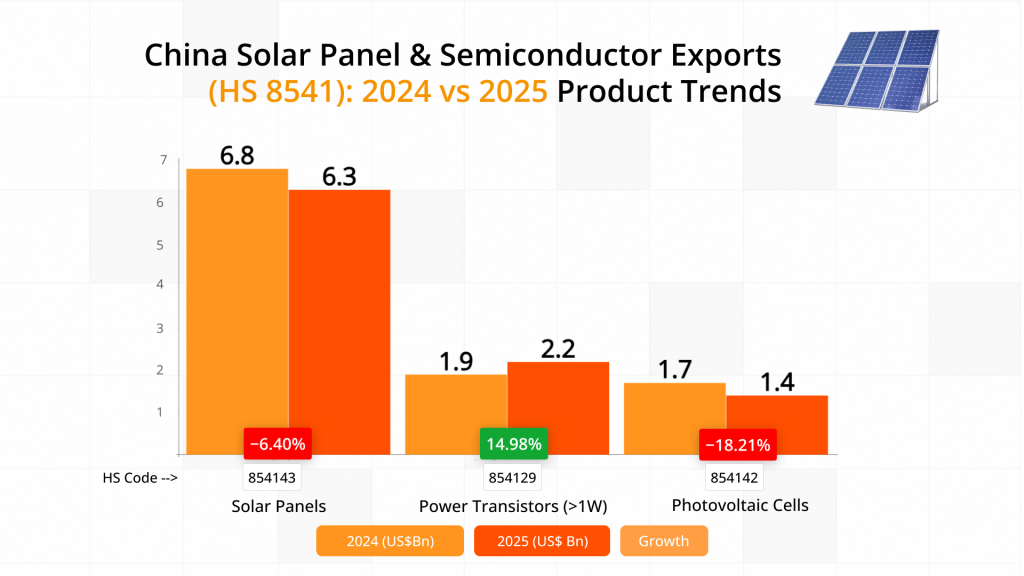
China Solar Panel & Semiconductor Exports (HS 8541): 2024 vs 2025 Product Trends
This HS 8541 product group shows a mixed trend over the entire years 2024 and 2025 data, unlike the battery and integrated-circuit groups. Solar panel and photovoltaic cell exports both fell, while power transistor exports — a more industrial, less commoditized product — rose nearly 15%.
- Solar panels (854143) –6.40% YoY in line with China’s broader 2025-2026 solar overcapacity adjustment
- The biggest loser was photovoltaic cells (854142), down 18.21%, suggesting buyers are shifting to finished panels or other raw cell suppliers.
- Bucking the trend were power transistors (854129), which were up 14.98%, suggesting demand from industrial and grid-equipment makers was more stable than from consumer-facing solar hardware.
- This split shows that China’s HS 8541 export category is not a single story, with solar-linked codes contracting while semiconductor-adjacent codes are expanding.
China Solar Panel & Semiconductor Exports (HS 8541): 2024 vs 2025 Product Trends
| HS Code | Product Description | 2024 (US$Bn) | 2025 (US$Bn) | Growth |
|---|---|---|---|---|
| 854143 | Solar Panels | 6.8 | 6.3 | −6.40% |
| 854129 | Power Transistors (>1W) | 1.9 | 2.2 | +14.98% |
| 854142 | Photovoltaic Cells | 1.7 | 1.4 | −18.21% |
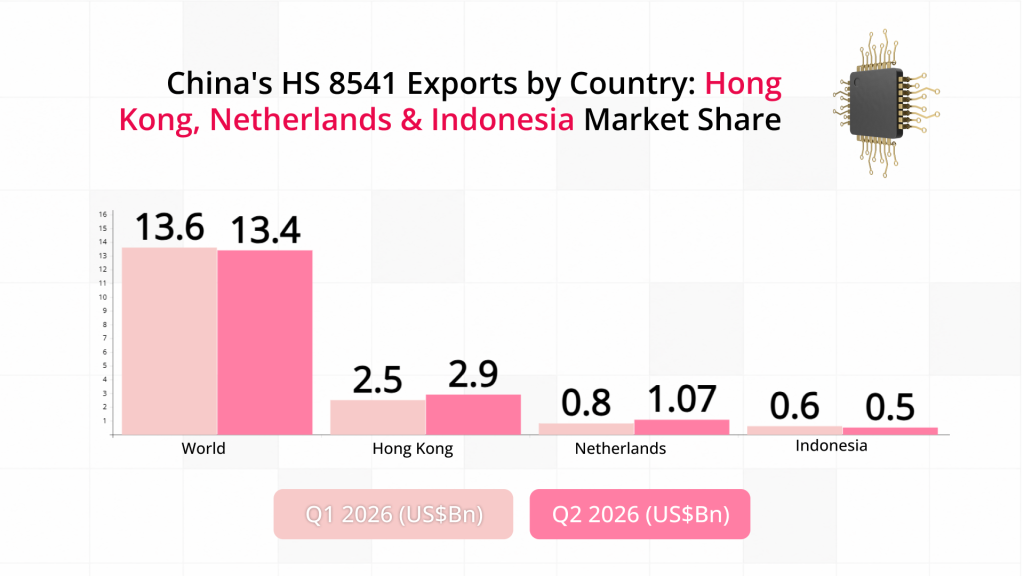
China’s HS 8541 Exports by Country: Hong Kong, Netherlands & Indonesia Market Share
World totals for this HS 8541 grouping dropped marginally (-1.13%) between Q1 and Q2 2026, but that overall drop masks sharply divergent country-level demand. Hong Kong and the Netherlands both posted double-digit growth, while Indonesia pulled back.
- Hong Kong grew 19.21%, consistent with its expanding role as a transit and re-export hub for Chinese tech exports headed to broader Asian and global markets.
- The Netherlands grew fastest at 30.05%, again illustrating its role as a European redistribution point rather than a single end-market.
- Indonesia was down 16.17%, which is a reminder that demand from Southeast Asia for this product group is not following the same directional trend as Europe.
- World totals are a little off, but the top buyers are growing, suggesting demand is consolidating to fewer, larger trade lanes, rather than spreading out.
China’s HS 8541 Exports by Country: Hong Kong, Netherlands & Indonesia Market Share
| Destination Country | Q1 2026 (US$) | Q2 2026 (US$) | Growth (Q1 → Q2) |
|---|---|---|---|
| World | $13,620,191 | $13,466,681 | −1.13% |
| Hong Kong | $2,496,001 | $2,975,545 | +19.21% |
| Netherlands | $825,753 | $1,073,930 | +30.05% |
| Indonesia | $693,747 | $581,549 | −16.17% |
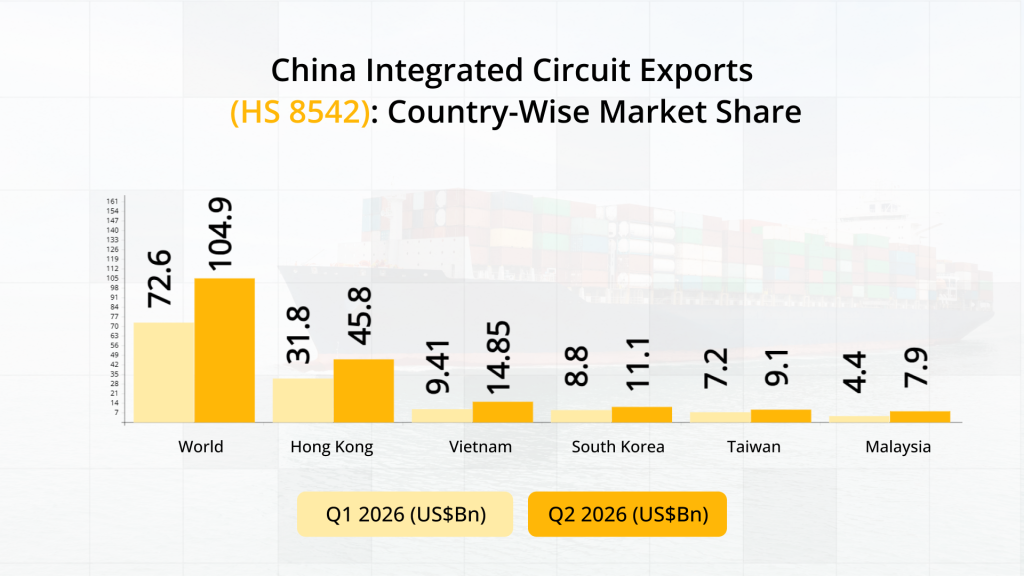
China Integrated Circuit Exports (HS 8542): Country-Wise Market Share
The fastest-growing category in this data set is China’s integrated circuit exports, which grew by 44.60% in value from Q1 to Q2 2026. The largest percentage gains, however, were in smaller destinations, with Hong Kong alone accounting for about 44% of the total in both quarters.
- Malaysia recorded the fastest growth at 78.50%, indicating its increasing significance in the assembly, testing and packaging of chips in the broader Asian semiconductor supply chain.
- Electronics output in Vietnam jumped 57.72%, further cementing its position as an emerging hub for electronics manufacturing and semiconductor assembly.
- Hong Kong, the largest value importer, remains a reflection of its well-documented role as a re-export corridor for chips into mainland China and beyond.
- Steady gains from two of the world’s most established semiconductor economies saw South Korea and Taiwan both gain about 26- 27%.
China Integrated Circuit Exports (HS 8542): Country-Wise Market Share
| Destination Country | Q1 2026 (US$) | Q2 2026 (US$) | Growth (Q1 → Q2) |
|---|---|---|---|
| World | $72,601,958 | $104,985,039 | +44.60% |
| Hong Kong | $31,880,405 | $45,870,649 | +43.88% |
| Vietnam | $9,412,529 | $14,845,916 | +57.72% |
| South Korea | $8,811,249 | $11,184,041 | +26.93% |
| Taiwan | $7,262,593 | $9,165,832 | +26.21% |
| Malaysia | $4,442,280 | $7,929,729 | +78.50% |
China Semiconductor Exports by Product (HS 8542): Memory Chips Lead Q2 2026 Growth
The single biggest driver of overall HS 8542 growth in China is memory integrated circuits (854232), which saw a 67.31% leap in a single quarter and now account for around 73% of the four product lines here. Processors and controllers, in contrast, hardly budged.
- Memory ICs soared 67.31%, following the global memory price rally that has buoyed DRAM and NAND values across the sector in 2026.
- Processors & controllers had a near-flat quarter, gaining just 1.82%, an outlier in the rest of the category.
- IC amplifiers grew 12.27%, a smaller product line but one of the more consistent growers in the group.
- The share of memory ICs in total exports of HS 8542 rose from around 63% in Q1 to roughly 73% in Q2, suggesting that growth in the category is increasingly concentrated on one product.
Why Is China’s Tech Export Mix Shifting in 2026?
The patterns above have three separate stories behind them, not happening in a vacuum. China’s semiconductor export surge is largely a memory chip story. The growing demand for high-bandwidth memory for AI accelerators is pushing Samsung, SK Hynix and Micron to shift capacity away from traditional memory chips, tightening supply and leading to a sharp rise in global DRAM and NAND prices through 2026. Chinese memory makers are selling into that same commodity segment, so their export values have climbed even where shipped volumes haven’t grown nearly as fast – a value story more than a volume story.
Second, the outsized share of Hong Kong across both the HS 8541 and HS 8542 tables points to its rise as China’s main chip re-export corridor. Hong Kong is said to have supplied about $124 billion in semiconductors to mainland China in the first five months of 2026 alone, more than half of China’s total chip imports, up from about a third a decade ago, as the city’s free-port status makes it a preferred routing point amid tightening US-China trade restrictions.
Third, the fall in solar panels is tied to a change in domestic policy, not to a drop in demand worldwide. Beijing has started phasing out export tax rebates on solar products after years of overcapacity and collapsing margins in manufacturing, and is introducing new consumption taxes on batteries and solar cells from September 2026 and April 2027, respectively. That policy sequencing helps explain why solar panel and photovoltaic cell exports both declined even as China remains the dominant global solar manufacturer, and it may also explain why battery exporters are showing stronger growth now — shipping ahead of the tax deadline.
What This Means for Buyers, Importers and Traders
These patterns in trade data have real-world implications for anyone shipping to or sourcing from China. With China’s September 2026 consumption tax deadline approaching, battery buyers that lock in contracts should expect prices and lead times to tighten as exporters have an incentive to front-load shipments before margins compress. Solar buyers, by contrast, are in a buyer’s market, with declining export values and China’s continued dominance in manufacturing capacity meaning pricing power remains with importers, though tariff and anti-dumping exposure varies by destination market. The flip side for semiconductor buyers is that memory chip prices are going up across the board, not just for Chinese-origin products, and that sourcing teams should take the 67% increase in export value as more of a pricing cue than a China-specific anomaly.
- Battery buyers are advised to secure volumes for Q3 2026 early, before the consumption tax skews the economics of exports.
- Solar shoppers: compare landed cost in a number of destination markets as anti-dumping and countervailing duties vary significantly by region.
- Semiconductor buyers: to know China story vs global, benchmark memory chip pricing vs global DRAM/NAND indices, not just China-origin export data.
- All buyers routing through Hong Kong: confirm final origin and compliance documentation. Hong Kong is a re-export hub, which can complicate country of origin reporting.
Frequently Asked Questions
What is China’s biggest tech export category in 2026?
Based on this China export data, integrated circuits (HS 8542) are the fastest-growing category, up 44.6% in value between Q1 and Q2 2026, well ahead of lithium-ion batteries (+3.1%) and solar-linked HS 8541 products, which declined slightly overall.
Why did China’s semiconductor exports grow so fast in 2026?
The growth is concentrated in memory integrated circuits, which rose 67.3% quarter-on-quarter. This tracks a global memory price rally tied to AI accelerator demand rather than a comparable jump in shipped volume.
Why is Hong Kong such a large importer of China’s semiconductors?
Hong Kong functions primarily as a re-export hub, not an end-market. Chips routed through Hong Kong’s free port are typically headed to the mainland or onward to other Asian markets, which inflates its share of country-level trade data.
Are China’s solar panel exports declining?
Yes, according to China export data, solar panel exports (HS 854143) fell 6.4% year-over-year, and photovoltaic cells (HS 854142) fell 18.21%, reflecting a domestic overcapacity correction and the phase-out of export tax rebates on solar products.
Which country is growing fastest as a destination for China’s lithium-ion-battery exports?
According to China export data, the Netherlands is the fastest-growing destination, which grew by 41.68% quarter-on-quarter, faster than any other major destination tracked here, including Germany, the United States, Vietnam, and Japan.
Which countries are growing fastest as importers of China’s integrated circuits?
Malaysia (+78.5%) and Vietnam (+57.7%) posted the fastest quarter-on-quarter growth among the countries tracked, both ahead of established semiconductor economies like South Korea and Taiwan, reflecting their expanding roles in chip assembly, testing, and packaging.
Is China’s tech export growth in 2026 driven by volume or by price?
Largely by price, at least in semiconductors. Chinese customs data shows China’s overall integrated circuit export value rose sharply in 2026 even though shipped volume grew far more slowly, pointing to a global memory-price rally as the main driver rather than a step change in Chinese chip output.
Key Takeaways
Of the three technology categories tracked, China’s semiconductor exports (HS 8542) are growing fastest—up 44.6% Q1-to-Q2 2026, led by a 67.3% jump in memory chip exports.
- Lithium-ion battery exports rose more steadily overall (+3.1%), with the Netherlands (+41.7%) and the United States (+20%) growing well ahead of top buyer Germany (+3.9%).
- Exports of solar panels and photovoltaic cells both fell, down 6.4% and 18.2% respectively, as China works through years of manufacturing overcapacity.
- Hong Kong’s disproportionate share of both HS 8541 and HS 8542 imports is a function of its status as a re-export corridor into mainland China and the broader region, rather than end use.
- Malaysia (+78.5%) and Vietnam (+57.7%) were the fastest-growing integrated-circuit import countries among those tracked, ahead of established players South Korea and Taiwan.
Unlock China Trade Intelligence
Access verified import-export shipment data, discover trusted buyers and suppliers, and make confident sourcing decisions using real-time trade intelligence.
Request Demo →