
For years, headlines have suggested that the world is moving away from China.
Factories are relocating. Companies are diversifying. Governments are encouraging domestic manufacturing. Countries like Vietnam, Mexico, Malaysia, and Indonesia are increasingly becoming part of global supply chains.
But here’s the reality that many businesses misunderstand.
The future of global manufacturing isn’t China versus the rest of the world. It’s China plus the rest of the world.
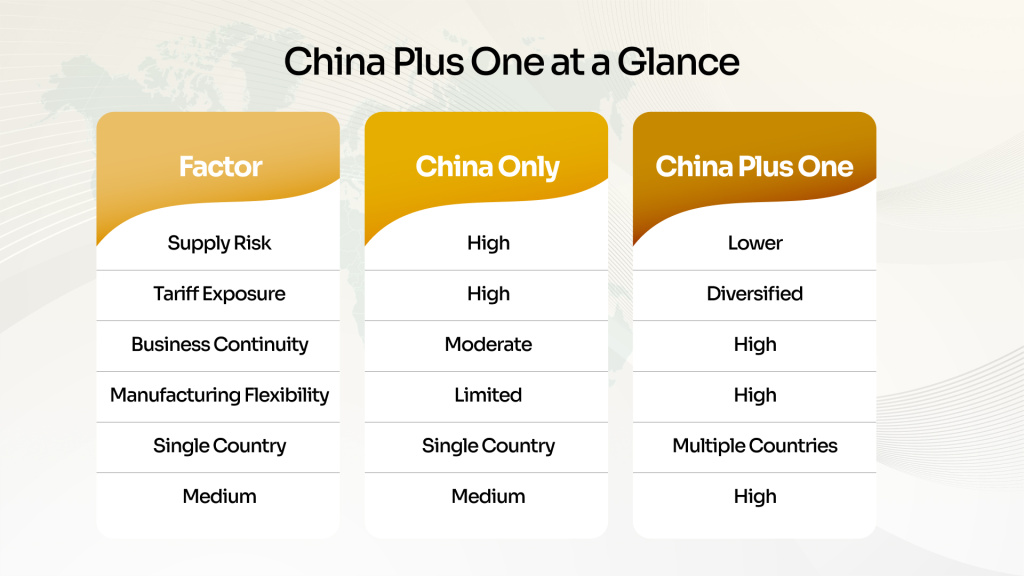
This is the essence of the China Plus One Strategy—a global sourcing strategy where companies continue to leverage China’s manufacturing strengths while establishing production or supplier relationships in one or more additional countries. Rather than replacing China, businesses are reducing dependency on a single manufacturing hub to improve resilience against geopolitical uncertainty, tariff changes, logistics disruptions, and rising operational risks.
The question for procurement leaders, sourcing managers, and global manufacturers is no longer ‘Should we diversify?’ It is not, “How can we diversify, increase cost, decrease quality, increase supplier risk?”
The answer is in marrying strategic sourcing with shipment-level trade intelligence.
What is the China-Plus-One Strategy?
The China Plus One Strategy is a supply chain diversification strategy where companies keep manufacturing or sourcing operations in China and add production in one or more additional countries. The objective is not to exit China but to reduce single-country dependency and improve business continuity.
This strategy allows companies to retain access to China’s mature supplier ecosystem while taking advantage of regional opportunities in countries better suited for specific products or markets, rather than a complete manufacturing relocation.
We will examine –
- A consumer electronics company could still buy semiconductors and batteries from China, but assemble the finished products in Vietnam.
- An auto manufacturer may produce parts in China, but then perform final vehicle assembly in Mexico, to service North American markets.
- A textile brand might get fabrics from China and make clothes in Bangladesh.
This balanced approach enables organizations to optimize costs, manage risks, and stay agile in an increasingly uncertain global trade environment.
Why Global Companies Are Diversifying Their Supply Chains
The China Plus One Strategy is being rapidly adopted due to several structural shifts in global trade.
Trade policies have become more unpredictable, making long-term sourcing decisions increasingly difficult for businesses that rely on a single manufacturing destination.
Geopolitical tensions, sanctions, export controls, and tariff disputes have further exposed the risks of concentrating production in one country. Recent disruptions have demonstrated that political decisions can reshape global supply chains almost overnight.
But rising labor costs in China’s coastal manufacturing belt have prompted companies that make labor-intensive products to seek other manufacturing locations.
Diversification is no longer just about cost savings.
Today’s procurement leaders are judged by their ability to create resilient, agile and data-driven supply chains that can absorb shocks.
Also read –
China’s Curbs on Export of Germanium & Gallium Soaring Price Globally
China’s Electric Vehicle Industry Shifts Gears: From Subsidies to Global Expansion
China’s European Ambitions: Trade, Tech, and Influence
How Geopolitical Sanctions Are Driving Supply Chain Diversification
The latest developments in Washington show how rapidly geopolitical decisions can change global sourcing strategies. In July 2026, the U.S. Senate passed a bipartisan sanctions bill that would allow the President to impose tariffs of up to 100% on imports from countries still buying large amounts of Russian oil and natural gas, with China among the largest of the impacted buyers. The legislation is not yet law, needing approval by Congress and the President, but it highlights a wider trend: trade policy is being increasingly deployed as a geopolitical tool rather than solely an economic one.
For global manufacturers and procurement teams, the implications reach beyond energy markets. Sourcing costs can be changed, supplier networks disrupted, and compliance risks increased with little warning by sudden tariffs, sanctions, export controls, and changing trade regulations. That growing uncertainty is a major factor in why corporations are spreading out their supplier base to multiple countries rather than a single manufacturing center. The China Plus One Strategy is no longer just about cutting costs; it is about creating resilient, nimble supply chains that can survive geopolitical shocks.
Business Insight: Companies that combine supplier diversification with shipment-level trade intelligence can identify alternative sourcing markets faster, evaluate country-specific risks, and respond proactively to changing trade policies before disruptions affect production.
Why China Still Dominates Global Manufacturing
Despite widespread diversification, China remains the world’s manufacturing powerhouse.
Why?
Manufacturing is not a day’s work.
China has built one of the world’s most integrated industrial ecosystems over the past three decades – suppliers, ports, logistics infrastructure, skilled labor, industrial parks, financing networks, and advanced manufacturing capabilities into a single interconnected network.
It is a hard ecosystem to reproduce.
China is still the world’s top exporter in many high-value sectors such as integrated circuits, smartphones, lithium-ion batteries, computer parts, electric vehicles, and solar panels. These sectors rely on complex supplier networks, precision engineering, and large-scale production capacity that few countries can currently match.
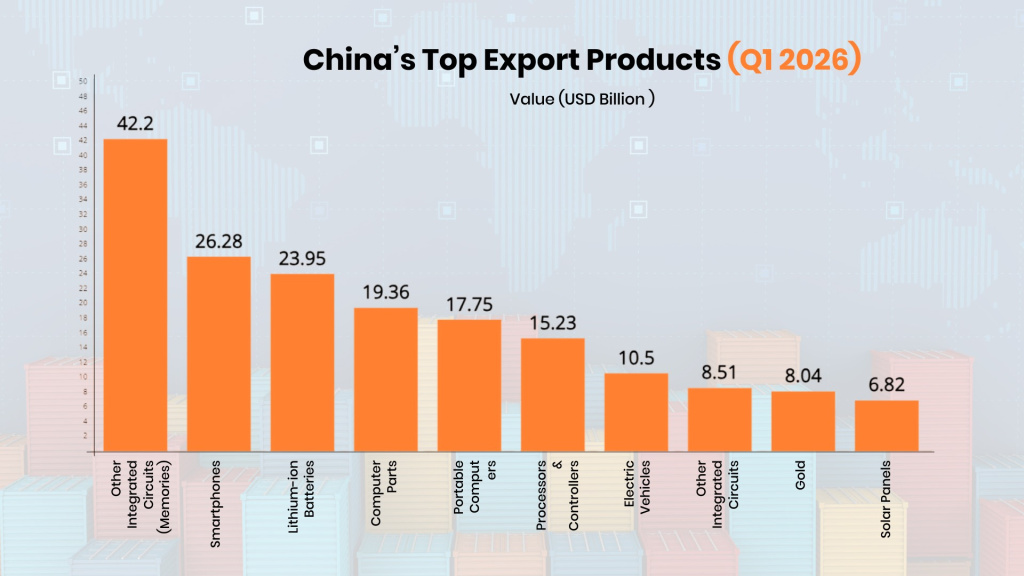
China’s Top Export Products (Q1 2026)
| HS Code | Product | Export Value (USD Billion) |
|---|---|---|
| 85423290 | Other Integrated Circuits (Memories) | 42.20 |
| 85171300 | Smartphones | 26.28 |
| 85076000 | Lithium-ion Batteries | 23.95 |
| 84733090 | Computer Parts | 19.36 |
| 84713090 | Portable Computers | 17.75 |
| 85423190 | Processors & Controllers | 15.23 |
| 87038010 | Electric Vehicles | 10.50 |
| 85423990 | Other Integrated Circuits | 8.51 |
| 71081200 | Gold | 8.04 |
| 85414300 | Solar Panels | 6.82 |
Business Insight: Assembly work may be shifted to other countries, but these export figures show that China remains the leader in high-value parts and cutting-edge manufacturing technology.
Which Countries Are Benefiting Most?
The China Plus One strategy isn’t about replacing China with anything. Instead, manufacturing is spreading across multiple countries, each specializing in different industries.
- Vietnam: A top destination for electronics assembly, footwear and apparel manufacturing.
- Mexico: Benefiting from nearshoring, attracting automotive and electronics manufacturers thanks to the advantages of the USMCA.
- Malaysia: Bolstering its position in semiconductor packaging, testing and advanced electronics manufacturing.
- Indonesia: Emerging as a key player in electric vehicle (EV) battery materials and critical mineral supply chains.
- Thailand: Retaining its dominance in automotive components, electrical equipment, and industrial manufacturing.
Best China Plus One Destinations by Industry
| Industry | Recommended Country | Competitive Advantage |
|---|---|---|
| Consumer Electronics | Vietnam | Mature electronics manufacturing |
| Automotive | Mexico | Nearshoring & USMCA |
| Semiconductor Packaging | Malaysia | Advanced semiconductor industry |
| Apparel | Bangladesh | Competitive labor costs |
| EV Batteries | Indonesia | Rich nickel resources |
| Industrial Machinery | China | Complete supplier ecosystem |
The key takeaway is clear: businesses should diversify by product category—not simply relocate their entire supply chain to one country.
Trade Intelligence: The Missing Piece in Global Sourcing
Finding overseas suppliers is easier than ever.
Another challenge is finding suppliers.
Contact details are available in supplier directories and B2B marketplaces, but they rarely show if a supplier has exported similar goods before, to reliable buyers, and in consistent amounts.
This is where Market Inside Trade Data can give you a competitive edge.
Procurement teams can answer key questions with shipment-level customs records:
- Has this supplier shipped my product before?
- Who are their existing customers?
- How often do they ship?
- What markets do they cover?
- Are the shipment volumes fairly steady?
- Can they handle long-term procurement needs?
Businesses have access to documented trade history rather than marketing claims, allowing for better supplier verification and risk assessment.
How Trade Intelligence Reduces Supply Chain Risk
How Trade Intelligence Reduces Supply Chain Risk
| Procurement Challenge | Business Risk | How Trade Data Helps |
|---|---|---|
| Finding Suppliers | Poor supplier selection | Discover verified exporters |
| Supplier Verification | Fraud & quality issues | Analyze shipment history |
| Competitor Analysis | Missed market opportunities | Benchmark sourcing strategies |
| Buyer Discovery | Limited expansion | Identify active importers |
| Country Risk | Tariff & geopolitical exposure | Compare trade trends |
| Demand Forecasting | Inventory imbalance | Analyze import-export data |
| Strategic Sourcing | High procurement risk | Use shipment-level intelligence |
Organizations that incorporate trade intelligence platforms into the procurement workflow can make faster, smarter sourcing decisions and reduce supplier and country risk.
China’s Top Trading Partners Reveal Another Story
One of the best indicators of China’s continued importance is its trade relationships.
Countries like Vietnam have emerged as important manufacturing locations, but they are also important importers of intermediate goods from China.
The United States, Hong Kong, and Vietnam are China’s biggest export markets, while Taiwan, South Korea, and Japan remain major suppliers of advanced components to Chinese manufacturers.
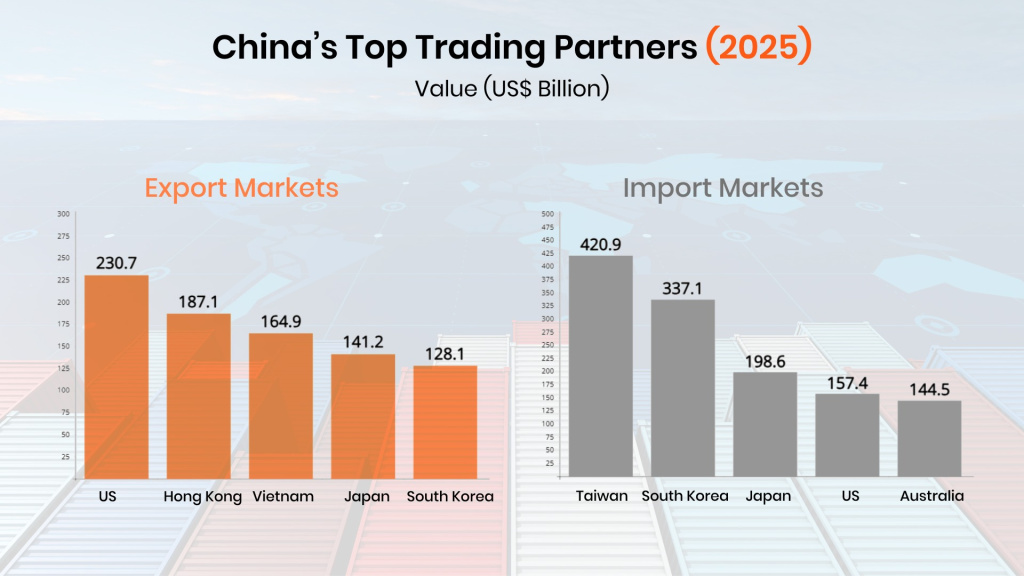
China’s Top Trading Partners (2025)
| Top Export Markets | Export Value (US$ Billion) | Top Import Sources | Import Value (US$ Billion) |
|---|---|---|---|
| United States | 420.9 | Taiwan | 230.7 |
| Hong Kong | 337.1 | South Korea | 187.1 |
| Vietnam | 198.6 | Japan | 164.9 |
| Japan | 157.4 | United States | 141.2 |
| South Korea | 144.5 | Australia | 128.1 |
These figures illustrate an important reality.
Many products labeled “Made in Vietnam” still depend on components manufactured in China.
Understanding these supply chain relationships is essential for managing tariff exposure and country-of-origin compliance.
Build a Smarter China Plus One Strategy with Export Genius
Better decisions lead to resilient supply chains.
Export Genius offers procurement teams verified customs data at the shipment level, supplier verification, buyer discovery, competitor benchmarking, HS Code analytics,s and verified trade intelligence at the country level.
- Instead of making assumptions, businesses can:
- Find verified global suppliers
- Verify supplier credibility with shipment historAnalyzeof competitor sourcing strategies
- Monitor import-export patterns in 200+ countries
- Real trade intelligence to reduce procurement risk
- Design resilient global sourcing strategies
Whether you are looking to expand into Vietnam, assess suppliers in Mexico, or optimize your sourcing strategy in China, trusted trade intelligence will provide the insight to make confident, data-driven decisions.
Ready to Future-Proof Your Supply Chain?
Book a demo with Export Genius and learn how verified import-export trade data can assist you in locating reliable suppliers, benchmarking competitors, mitigating sourcing risks, and developing a robust China Plus One strategy for 2026 and beyond.
Conclusion
The China Plus One Strategy is not about leaving China but rather about building smarter and more resilient supply chains.
China will remain important for advanced manufacturing as countries such as Vietnam, Mexico, Malaysia, Thailand and Indonesia continue to build up global production networks. The winners are those with a combination of diversification and data-driven procurement, not those who are going for the lowest cost.
In a world where geopolitical shifts, tariffs and supply chain disruptions can reshape markets overnight, trade intelligence is not optional—it’s a strategic advantage. The companies that leverage validated shipment data, supplier insights and global trade analytics will be best positioned to identify opportunities, reduce risks and thrive in the next generation of global commerce.
Unlock China Trade Intelligence
Access verified import-export shipment data, discover trusted buyers and suppliers, and make confident sourcing decisions with real-time trade intelligence.
Request Demo →