Mexico has approved tariffs of up to 50% on China, India and other Asian countries. This marks one of the most significant trade policy shifts in North America in recent years. The move signals a broader recalibration of global supply chains; one shaped by increasing geopolitical tensions, protectionism, and the accelerating push toward nearshoring. Market Inside explains how this tariff imposed by Mexico on Asian countries could reshape global trade and impact which sectors and how it could impact exporters.
Why Mexico Imposed the Tariffs on Asian Countries
Mexico’s new tariff regime is driven by several probable overlapping priorities:
Aligning with North American Trade Dynamics
As USA-China tensions continue, Mexico is positioning itself more closely with North American countries for trade interests. Higher tariffs discourage the indirect entry of Chinese goods into the U.S. via Mexico-something Washington has been increasingly vocal about.
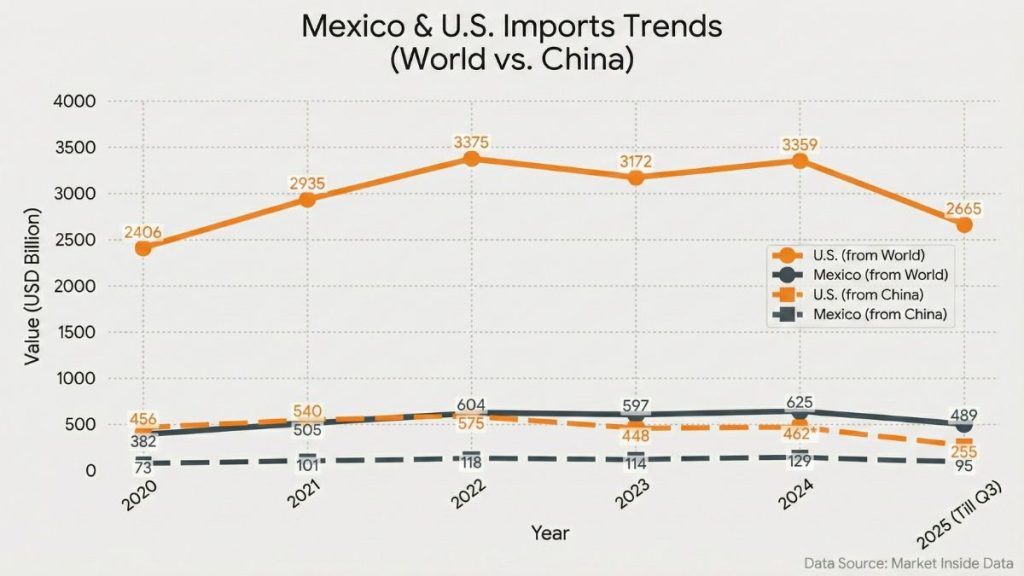
Yearly Trends of Mexico and U.S. Imports
| Year | Mexico Imports from World | U.S. Imports from World | Mexico Imports from China | U.S. Imports from China |
| 2020 | 382 | 2,406 | 73 | 456 |
| 2021 | 505 | 2,935 | 101 | 540 |
| 2022 | 604 | 3,375 | 118 | 575 |
| 2023 | 597 | 3,172 | 114 | 448 |
| 2024 | 625 | 3,359 | 129 | 462 |
| 2025 (Till Q3) | 489 | 2,665 | 95 | 255 |
*******Value USD Billion
Encouraging Local Manufacturers
Local manufacturers – especially in steel, electronics, textiles, and machinery – have long stated concerns about low-cost imports from China and other Asian countries undercutting their competitiveness. The tariffs aim to create a more level playing field.
Which Sectors are Most Affected
While the tariffs imposed by Mexico on imports from Asian countries cover a broad range of product categories, the sectors most likely to feel immediate impact include:
Steel and Metal
Steel has been one of the primary pressure points. Tariffs up to 50% will support domestic producers but increase prices for automotive, construction, and heavy machinery manufacturers.
Electronics
Components like circuit boards, semiconductors, and consumer electronics heavily sourced from China will face higher landed costs. This could disrupt assembly operations or push companies to diversify suppliers.
Textiles and Apparel
Clothing manufacturers using Chinese fabrics and trims may either raise prices or accelerate supply diversification toward Latin America.
Automotive Parts
Mexico’s booming auto sector relies significantly on Asian parts and components. Higher input costs could affect production timelines, margins, and pricing.
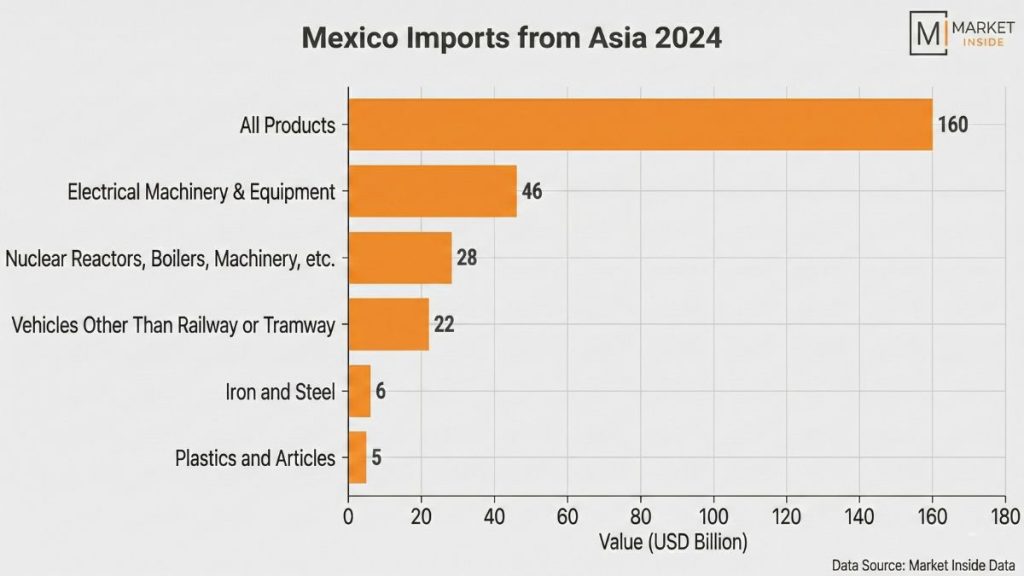
Mexico Imports from Asia 2024
| All Products | 160 |
| Electrical Machinery & Equipment | 46 |
| Nuclear Reactors, Boilers, Machinery, etc. | 28 |
| Vehicles Other Than Railway or Tramway | 22 |
| Iron and Steel | 6 |
| Plastics and Articles | 5 |
*******Value USD Billion
How the Tariffs Could Reshape Global Trade
Any country imposes tariffs on imports from other countries impacts international trade, particularly business of exporters as they have look for other trade alternatives. After the United States, Mexico has imposed tariffs on Asian countries including India and China. Market Inside outlines certain points that will help you understand how Mexico’s tariff approval could impact global trade.
Changing Trade Dynamics in North America
With higher tariffs and increasing the cost of Asian imports, global companies may expand operations in Mexico to stay competitive in North America. This trend could lead to:
- Increased FDI flows into Mexican manufacturing zones
- Rapid growth in industrial parks
- Jobs shifting from Asia to Mexico
Supply Chain Reconfiguration Across North America
Companies operating under USMCA will look to reduce import dependence from Asia. Expect shifts such as:
- More regional sourcing within Mexico and the U.S.
- Increased demand for Latin American suppliers
- New investment in local component manufacturing
Increasing Business Costs for Short Period
Tariffs typically cause short-term disruptions until a deal is cracked between the countries. High product costs, logistics and other costs are experienced by the businesses. What these costs are? Find below:
- Higher import costs
- Increased compliance and logistics complexity
- Potential delays as companies find alternate suppliers
- Small and mid-sized businesses dependent on Asian goods may feel the pressure most.
Asian Exporters Feel Business Pressure
China, South Korea, Vietnam, and other Asian exporters could lose market share in Mexico. Some may consider:
- Setting up operations in Mexico
- Partnering with Mexican distributors
- Rerouting exports to other Latin American markets
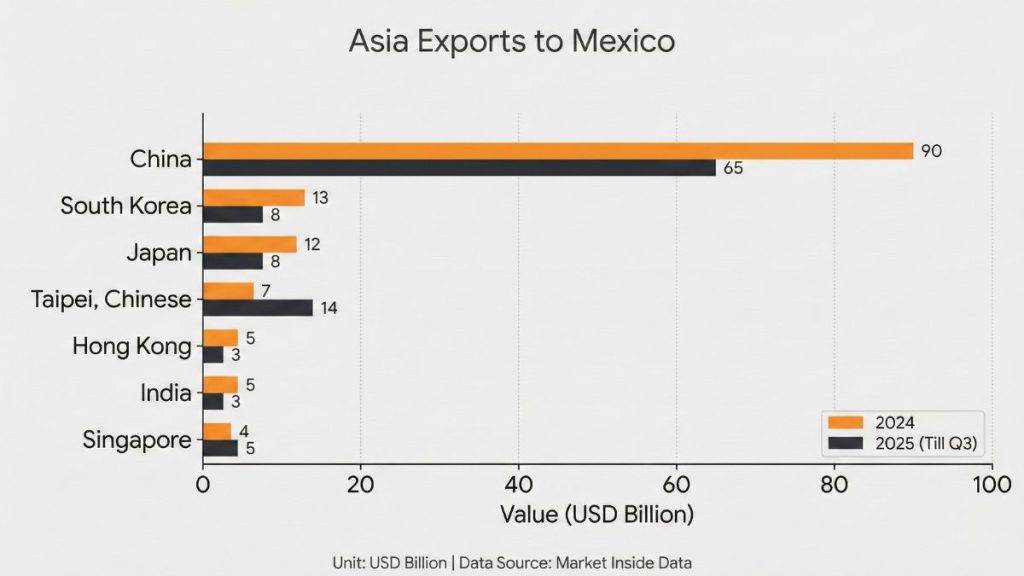
Asia Exports to Mexico 2024-25
| Country | 2024 | 2025 Till Q3 |
| China | 90 | 65 |
| Japan | 12 | 8 |
| South Korea | 13 | 8 |
| Hong Kong | 5 | 3 |
| Singapore | 4 | 5 |
| Taipei, Chinese | 7 | 14 |
| India | 5 | 3 |
****Value USD Billion
Strategic Advantage for Mexico in Global Trade Routes
As companies seek tariff-free access to the U.S. and Canada under USMCA, Mexico becomes even more attractive as a manufacturing base. This strengthens Mexico’s position as a gateway to North America, especially in industries like automotive, electronics, and consumer goods.
What It Means for Importers and Exporters
For Mexican Importers
- Expect higher landed prices for Asian goods
- Evaluate alternative suppliers in Latin America or North America
- Revisit contracts to adjust for tariff-driven cost changes
For Asian Exporters
- Competitiveness in Mexico may decline sharply
- Consider nearshoring or joint ventures within Mexico
- Explore diversification into Central & South America
For U.S. and Global Companies
- Mexico becomes an even more strategic sourcing and manufacturing location
- Nearshoring investments could offer long-term cost and logistics benefits
The Bigger Picture: A Shift Toward Regionalized Trade
Mexico’s 50% tariffs should be viewed not as an isolated policy but as part of a broader global trend: the regionalization of supply chains. As geopolitical tensions reshape trade flows, countries across the world are prioritizing:
- Local manufacturing
- Reduced dependence on single-country suppliers
- Strategic alliances within economic blocs
Mexico’s decision reinforces North America’s push to build a more resilient, self-sufficient manufacturing ecosystem.
Conclusion
Mexico’s approval of up to 50% tariffs on China and other Asian countries represents a major turning point for global trade. While the move may raise costs in the short term, it accelerates long-term shifts toward nearshoring, diversification, and tighter North American supply chains.
For businesses, the message of Market Inside for global exporters and importers is clear:
Adapt now, or risk falling behind in a rapidly changing trade landscape.
Schedule a demo to understand how tariffs impact global trade of commodities both in positive and negative way by accessing import export trade data with actual shipment records.