Canada is facing one of the most uncertain global trade environments in recent years. With supply chains under strain, geopolitical tensions escalating, and traditional trade partners becoming less predictable, Ottawa is increasingly looking toward India — the world’s fifth-largest economy — as a strategic partner for the future.
The mounting trade risks from China-U.S. tensions, protectionist measures, and geopolitical realignments are pushing Canada to diversify its economic partnerships. India, with its growing consumer base, expanding manufacturing capabilities, and stable economic outlook, offers exactly that.
Why India Is Becoming a Key Partner for Canada
Diversification Away from Traditional Partners
Canada has long relied on the U.S. and China for trade. But as relations with Beijing remain tense and Washington pursues protectionist policies, India presents a new, growing market that can reduce overdependence.
A Rising Economic Powerhouse
India’s economy is projected to be among the world’s fastest-growing in 2025, with a strong push in sectors like technology, renewables, infrastructure, and manufacturing — areas where Canada can collaborate and invest.
Strategic Geopolitical Alignment
India’s position as a neutral yet influential global player aligns with Canada’s interest in building resilient, rules-based trade partnerships outside great-power rivalries.
Expanding Bilateral Trade
In recent years, bilateral trade between Canada and India has been steadily increasing, with opportunities in agriculture, clean energy, education, technology, and critical minerals.
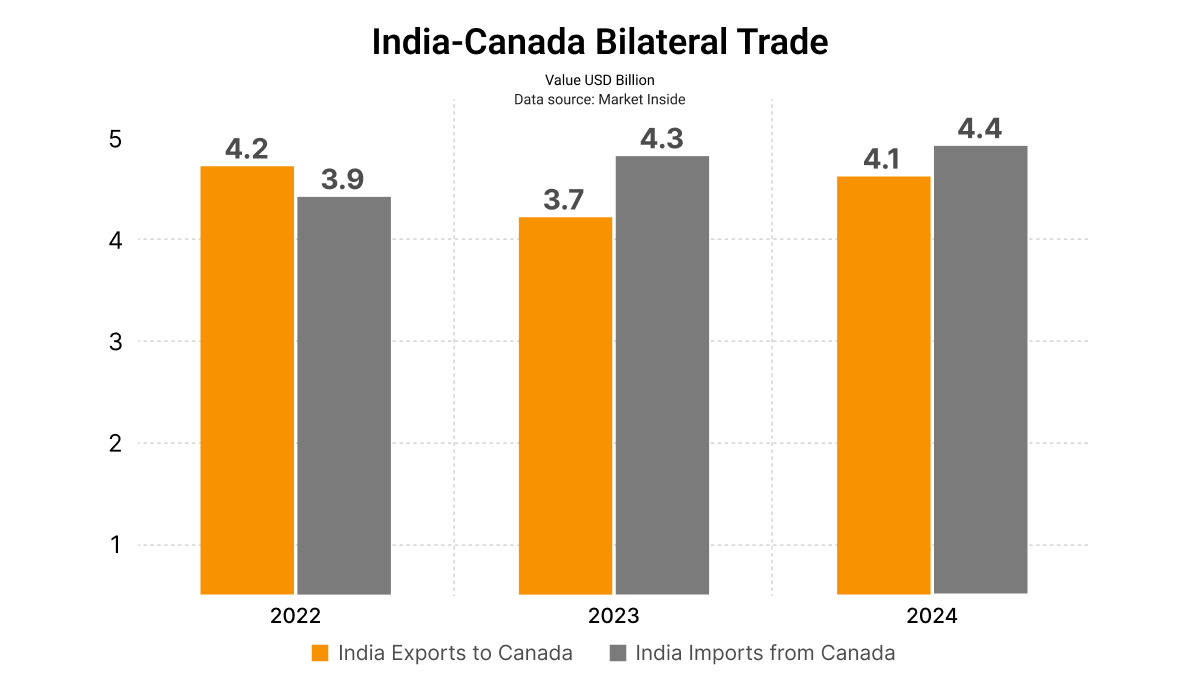
| Year | India Exports to Canada | India Imports from Canada |
| 2022 | 4.2 | 3.9 |
| 2023 | 3.7 | 4.3 |
| 2024 | 4.1 | 4.4 |
******Value USD Billion
Sectors Driving Canada–India Trade Growth
| Sector | Key Opportunity Area | Why It Matters |
| Agriculture | Pulse exports, fertilizers, food processing | India is a major market for Canadian agri goods |
| Energy | LNG, renewables, hydrogen | Supports India’s green transition |
| Technology | AI, IT services, fintech | Growing tech collaborations |
| Education | International students, research | India is Canada’s top source of foreign students |
| Critical Minerals | Lithium, nickel, cobalt | Supports clean energy supply chains |
What’s Driving Trade Risk for Canada
- Geopolitical Tensions: U.S.–China rivalry, Ukraine conflict, Red Sea disruptions
- Supply Chain Disruptions: Pandemic aftershocks and logistical bottlenecks
- Protectionism: Rising tariffs, subsidies, and trade barriers globally
- Climate & Resource Shifts: New regulations and carbon border taxes are changing trade flows
Amid these challenges, India offers a relatively stable and fast-growing market, making it an increasingly important partner for Canadian exporters and investors.
The Strategic Road Ahead
While Canada’s growing trade dependence on India presents significant economic opportunities, it also requires careful strategy. Ottawa will need to:
- Accelerate negotiations for the Early Progress Trade Agreement (EPTA).
- Strengthen investment frameworks to attract Indian companies.
- Expand collaboration in green energy, critical minerals, and technology.
- Build long-term supply chain partnerships to reduce exposure to global shocks.
Conclusion
As global trade risks mount, Canada’s pivot toward India is more than a diplomatic gesture — it’s a strategic necessity. By deepening economic and trade ties with one of the world’s most dynamic economies, Canada can strengthen its resilience, diversify supply chains, and future-proof its trade strategy in an unpredictable world.